
Motor vehicle services notices can trigger a spectrum of emotions depending on their legitimacy. For local car owners, used car buyers and sellers, and small business fleet operators, these notices can be crucial for vehicle registration, compliance, or potential fines. However, the digital age has ushered in a wave of scams that exploit unsuspecting individuals through fraudulent notices. Understanding how to navigate these communications is essential for protecting one’s interests. This article will guide you through identifying the validity of motor vehicle services notices, enabling you to differentiate between genuine correspondence from government agencies and deceptive scams. You will learn key indicators of legitimate notices, steps for confirming their authenticity, the risks attached to fraudulent communications, and the official resources available for verification.
Red Flags and Real Names: Verifying the Legitimacy of Motor Vehicle Services Notices
When an unexpected notice lands in your inbox or slips under your door, the moment you unlock its seal is the moment you decide whether to act or to verify. The stakes are not small: delayed renewals, missed inspections, or the mismanagement of a safety recall can carry penalties, and the digital era has blurred the line between legitimate government outreach and sophisticated impersonation. In this landscape, the question “is this motor vehicle services notice legit?” demands a careful, unhurried scrutiny that rests on two pillars: trust in the source and clarity of the content. Genuine notices come from recognized governmental bodies and carry specific, verifiable details that your everyday correspondence rarely includes. Scams, by contrast, cling to urgency, hollow promises, and a push toward clicks or replies that uncover more data or install malware. The distinction is not always obvious at first glance, but it becomes clearer when you consider what such notices are supposed to do, what they include, and how official channels recommend you respond when doubt lingers.
A genuine motor vehicle services notice, in essence, is a formal communication about services your vehicle may require or obligations you must fulfill. It is usually issued by a government agency such as the Department of Motor Vehicles or its equivalent in another jurisdiction. The content is not arbitrary; it is tethered to records about your vehicle and your ownership status. A legitimate notice will typically contain the full name of the recipient, the vehicle identification number, and a unique reference number that you can cross-check against the issuer’s records. These details are not decorative flourishes. They serve as anchors that allow you to verify authenticity through official channels rather than through the message itself. The purpose of such notices is often practical and mandatory: a scheduled vehicle inspection, a renewal deadline for registration, or a safety recall that requires action to keep your vehicle roadworthy. The language, too, tends to be precise rather than sensational, outlining the steps you must take with reference to specific regulations or timelines.
The flip side—the indicators of a scam—rests on a different logic. Scammers rely on urgency and fear. They try to provoke immediate action by implying penalties or service suspensions unless you hurry. They may deploy a multi-channel approach: a message by email, a text, or even a phone call, each designed to look like an official communication at a glance. The requests are frequently personal in tone, nudging you to click a link, download a file, or disclose information that would be inappropriate for an authentic government notice to solicit via that route. When the call to action centers on providing sensitive data or verifying critical details through a dubious portal, or when the message uses threats of late fees, it should be treated as a red flag. In such moments, trust must yield to verification, and you should pause long enough to check the message’s provenance before you proceed.
To separate the wheat from the chaff, consider the verification steps that seasoned readers use whenever a motor vehicle notice lands in their hands. First, verify the sender. Legitimate notices originate from domain addresses and phone numbers associated with government entities. If you see an address that ends with a government domain—such as a domain that clearly correlates to a state or national motor vehicle authority—it becomes a strong pointer toward authenticity. However, a government-stamped seal alone does not guarantee legitimacy. A careful examination of the sender’s contact channel is essential, because even sophisticated impersonations can mimic official branding. Second, examine the branding cues with a trained eye. Authentic correspondence typically includes official logos, case identification numbers, and references to applicable statutes or regulations that govern the notice’s purpose. The typography, color schemes, and paper quality (in physical mail) are not arbitrary; they are part of a standardized pipeline that a government agency uses to communicate with residents. If any of these elements seem oddly generic, inconsistent with prior notices you have received, or misaligned with known branding guidelines from the agency, treat the message with heightened skepticism.
Third, approach links and attachments with caution. The moment a notice asks you to click a link or download a form, you should pause. Links can lead to phishing sites designed to harvest credentials or install malware, while attachments can contain code that compromises your device. A legitimate notice will not compel you to provide sensitive information through insecure channels or to reveal personal identifiers in response to an unsolicited outreach. If a link is present, hover over it to see the URL, and, when in doubt, do not click. Fourth, exercise direct contact with the issuing agency through verified channels. Do not rely on contact information supplied in the suspicious message itself. Instead, navigate to the official government portal or call a number published on the agency’s official site. With many departments, including states’ DMVs, there are dedicated portals or hotlines for consumer inquiries. In California, for instance, the DMV has an established process for identifying genuine notices, and their official portal provides guidance on distinguishing authentic communications from scams. Relying on official pathways protects you from misdirection and ensures you are comparing the notice against your own vehicle records rather than a counterfeit version of them.
The practical takeaway is straightforward: treat every motor vehicle notice with a default stance of verification, not reflex action. This approach reduces the risk that a well-crafted scam could slip through and saves you from hastily divulging information or making rushed financial commitments. In applying these steps, you are not merely protecting personal data; you are safeguarding the integrity of your vehicle’s status and your own time. A telling sign that a notice is legitimate is the alignment of the message with expected administrative steps. If the notice speaks to a mandatory service—such as a required inspection, an upcoming renewal, or a safety recall—and it provides a conduit to obtain or verify the necessary action without pressuring you to divulge confidential information, you are likely dealing with a legitimate communication. Conversely, if the notice promises something urgent that could disrupt your driving privileges unless you act immediately, and it directs you to an unfamiliar portal or requests sensitive details, you should disengage and verify through official channels.
In the broader landscape of consumer protection, the guidance for identifying and responding to fraudulent vehicle-related communications is reinforced by authoritative resources that emphasize verification and direct contact with official authorities. The overarching principle is to substitute suspicion for speed. If you are uncertain, you should not respond to the unsolicited message or engage with the linked content. Instead, go to the official website of your local DMV or relevant government department and seek confirmation. The concern here is not only about the risk of data theft but also about the potential for misidentification of your vehicle records, which could lead to penalties or miscommunications about the status of your vehicle. In addition to direct verification, readers can benefit from broader consumer protection resources that outline common scams and recommended practices for vehicle-related notices. For additional authoritative guidance on identifying and responding to fraudulent vehicle-related communications, refer to the official U.S. Department of Transportation’s consumer protection resources: https://www.transportation.gov/consumer-protection. This external anchor provides a framework that complements local DMV procedures and underscores why verification through official channels remains the most reliable defense against misdirected notices.
To weave practical experience with official guidance, consider how a careful reader might approach a notice that appears suddenly on a screen after a routine drive. The reader might pause to compare the notice’s reference numbers with those on prior communications, confirm the VIN matches the vehicle in question, and check whether the stated deadline aligns with the standard renewal or inspection cycles in that jurisdiction. If the message references a unique reference number or a case-specific identifier, the reader can, in many jurisdictions, cross-check this number directly on the DMV’s official portal or by calling the agency’s verified line. A legitimate notice will not only provide a pathway to action but will also invite the recipient to contact the agency for confirmation if any doubt remains. This dual pathway—clear action steps and a verifiable route to confirmation—distinguishes authentic government correspondence from the ambush style of fraud.
For readers who want a broader discussion that ties into vehicle maintenance and the everyday realities of owning and operating a vehicle, an internal resource worth consulting is the KMZ Vehicle Center blog, which offers practical topics that illuminate how responsible vehicle management intersects with regulatory requirements. KMZ Vehicle Center blog.
As this chapter continues to unfold within the larger narrative of the article, the thread remains consistent: legitimacy is earned through provenance, specificity, and a disciplined approach to verification. When you encounter a motor vehicle services notice, you are not merely deciding whether to act; you are choosing to engage with your own civic infrastructure in a way that preserves accuracy, safety, and time. By prioritizing sender verification, branding cues, cautious handling of links, and direct reconciliation with official channels, you strengthen your capacity to discern authentic notices from the noise of scams. The framework is not a rigid checklist but a lens through which to read every notice with confidence rather than alarm. In the end, legitimacy rests on a simple premise: contacts that originate from trusted governmental entities, with concrete vehicle details and a clear, noncoercive path to action, deserve your careful attention and prompt, informed response.
Reading the Signals: How to Tell a Motor Vehicle Services Notice Is Legit
When a motor vehicle services notice lands in your inbox, mailbox, or on your dashboard, its legitimacy hinges on more than a polite tone or a familiar logo. It hinges on a careful reading of origin, purpose, and the practical details that allow you to verify its authenticity through trusted channels. In a landscape where scammers routinely mimic government communications, a legitimate notice is not a matter of guesswork or impression. It is a document you can trace back to a real authority, with clear, verifiable information and a process that invites validation rather than pressure. The distinction is not merely academic. It affects compliance with the law, the safety of your vehicle, and your own financial security. To understand what makes a motor vehicle services notice trustworthy, it helps to think of the notice as a signal, a carefully calibrated message designed to prompt a specific, accountable action without compromising security or accuracy.
One of the most reliable anchors in assessing legitimacy is the issuing authority. A genuine notice comes from a recognized and verifiable source. In the United Kingdom, for instance, the Department for Transport or the Driver and Vehicle Licensing Agency are typical reference points for official communications about vehicle testing, recalls, or mandated maintenance. In other regions, similar government bodies or authorized service networks perform this function. The core rule is simple: verify the sender through trusted directories or the official site rather than relying on a phone number or email address embedded in the message alone. A legitimate notice will often make this easy by listing a verified contact method, a direct link to an official portal, and a physical address that you can cross-check. If any element feels off—an odd domain, a sender that cannot be traced to an agency, or a contact method that demands you abandon official channels—that fault line should prompt you to pause and verify.
Beyond the origin, a legitimate notice carries precise, high-fidelity vehicle information. This is not a generic reminder; it is data drawn from official records. Expect to see the full Vehicle Identification Number, the license plate number, the registered owner’s name, and the registration date, all present in a format that aligns with official databases. These details are not easily forged. The more exact the data, the stronger the case that the notice is real. Scammers tend to rely on vague statements or partial identifiers, hoping you won’t notice the gaps or will fill them in with guesses. A genuine notice minimizes ambiguity because it must align with regulatory and registry records that are protected and audited. If the document lacks specific identifiers or uses placeholders, treat it as suspicious until you can confirm its origin through a trusted source.
A notice should also be crystal about its purpose and the action it requires. Government and authorized bodies issue notices for concrete reasons: a mandatory recall, an upcoming MOT or equivalent test, or maintenance triggered by mileage or time intervals. The notice should specify exactly what you need to do, where you should go for service, any deadlines, and whether there is a cost involved. If a communication suggests you must act immediately, asks for a fee to be paid in an unusual way, or directs you to provide sensitive personal data on a dubious form, that is a red flag. Real, legitimate notices spell out the steps with practical logistics and leave room for verification rather than pressure.
The tone and presentation of a notice matter as well. Authentic communications are professionally formatted, free from obvious spelling or grammatical errors, and aligned with the formal language typical of official correspondence. They frequently include official logos, document numbers, and references to applicable regulations or statutory frameworks. If a notice reads like a marketing flyer, uses informal language, or relies on sensational claims, it’s wise to pause and re-check. The combination of branding cues and regulatory references—such as a statute or section number related to road safety or vehicle testing—creates a credible architectural framework for the document. When you see these markers, you aren’t merely looking at a piece of paper; you are looking at a line of defense designed to prevent misrepresentation.
Another essential feature is the availability of secure and verifiable contact methods. A legitimate notice provides more than a single contact point. It should offer at least one dedicated hotline, an official website URL, and a physical address you can visit or verify through the agency’s publicly listed channels. Reputable organizations do not press recipients to confirm or respond via personal email addresses, unsecured chat apps, or unfamiliar phone numbers. They encourage you to use verified channels and, if possible, to corroborate information through the official portal or a numerically verifiable reference. This approach reduces the likelihood of phishing attempts and ensures that you can track your interaction with the issuing authority if questions arise later.
A crucial safeguard is the absence of requests for immediate payment or highly sensitive personal data through insecure channels. Real vehicle service notices do not trap you with urgency that bypasses due diligence. They do not demand bank details, Social Security numbers, or passwords via email or text, and they avoid high-pressure tactics that compel you to act before you’ve had time to verify. If a message tries to create a sense of inevitability—an implied consequence for noncompliance—without providing a verifiable path to confirm authenticity, assume it’s not legitimate. Any request for upfront payment should be validated through official, independent channels before you consider complying.
The digital dimension adds another layer of verification in today’s world. Many jurisdictions now rely on electronic notices that are digitally signed or issued through secure portals. Verification tools exist to confirm the authenticity of these documents, ensuring the digital footprint matches the issuing authority’s records. When a notice comes electronically, you should be able to trace a secure signature, a timestamp, and a verifiable document ID back to the issuer. If you encounter a digitally delivered notice that lacks a verifiable signature or directs you to an unfamiliar platform, proceed with caution and verify through official portals.
Putting these indicators into practice requires a deliberate, calm process. Start with the sender. Look up the entity on the official government or regulatory website and confirm the contact details you have match those listed there. Next, compare the vehicle data to your records—VIN, plate, ownership, and registration—asking yourself whether the information aligns with your documentation. Then read the notice’s stated purpose and required actions. Are the deadlines reasonable and explicit? Are the service locations legitimate and registered, or do they resemble generic street addresses without regulatory ties? If any of these questions trigger doubt, pause and escalate through official channels rather than replying to the notice directly.
If doubt persists, the safest path is to verify via the official pathway rather than reacting to unsolicited messages. Contact the relevant department or authorized dealership through confirmed numbers and websites, not through links embedded in the message. In some cases, you may discover that the notice actually originated from a legitimate source but was issued to a different vehicle in your region, or it may be a reminder for something the vehicle owner is legally obliged to address. In either case, a cautious, verification-first approach protects you and your vehicle. For practical considerations that complement these verification steps, readers may find additional context and guidance in established maintenance resources, such as the KMZ Vehicle Center blog, which offers accessible, vehicle-ownership related content you can consult as part of a broader, responsible maintenance mindset.
For those who want a definitive external reference on the subject, official government guidance on vehicle reminder notices, including how to recognize legitimate communications and how to respond, is available through credible governmental portals. This external resource provides standardized criteria for identifying authentic notices and outlines recommended verification procedures so vehicle owners can act with confidence rather than haste. You can review this guidance to supplement the internal checks described above and to ensure your actions align with national or regional regulations. UK government guidance on vehicle reminder notices.
In sum, a legitimate motor vehicle services notice is characterized by a trustworthy origin, precise vehicle data, a clear, actionable purpose, professional presentation, accessible verification channels, and a refusal to rely on urgency or insecure data requests. The more these elements align with official records and protocols, the stronger the case that the notice is legitimate. When in doubt, verify through official portals, cross-check with the agency’s publicly listed contact points, and use trusted resources to inform your next steps. This approach protects not only your finances but the safety and compliance of your vehicle as well. If you want to connect practical maintenance insights with the broader responsibility of responding to legitimate notices, you can explore relevant discussions in the KMZ Vehicle Center blog, which offers broader context for keeping vehicles in good condition between formal notices. KMZ Vehicle Center blog.
null
null
Is That Motor Vehicle Services Notice Legit? Verifying Authenticity
A motor vehicle services notice landing in your mailbox or inbox can trigger a warning signal. The key question is: is this legitimate or a scam designed to grab your money or personal data? The answer comes from checking the sender, branding, and contact paths, and by verifying through official channels before acting.
Start with origin: Does the notice come from a recognized government agency or its official contractors? If the sender is unfamiliar, suspect. Look for official branding, an identifiable case number, and references to relevant laws or procedures. If these are missing or look improvised, treat it as suspicious. Be cautious with links and attachments; legitimate notices usually direct you to verify through official portals rather than a private payment page.
Use the DMV’s official website or helplines found on official sites to confirm authenticity. In practice, verify by calling the DMV using a number obtained from the official website rather than the number in the notice. Do not share personal data or payment information until you have confirmed the source. Document the notice: save a screenshot, capture sender details, and note any case numbers or references.
The risks include financial loss, identity theft, and malware exposure. Scammers may use urgent language to pressure immediate payment or data sharing. Pause, cross-check, and act only through official channels.
If in doubt, report suspicious notices to consumer protection authorities. Some jurisdictions publish guidelines for recognizing genuine notices and steps for verification. For further guidance, see the FTC’s resources on vehicle service notices at https://www.consumer.ftc.gov/articles/0295-vehicle-service-notices
Verifying Motor Vehicle Notices: Navigating Official Channels to Separate Legitimate Alerts from Scams
Notices about motor vehicle services arrive in many forms: email, SMS, letters, or even in-app messages. The question they pose is not only about the content of the notice but about where it comes from and what that origin implies for legitimacy. A notice that originates from a recognized government authority is typically trustworthy; one that springs from an unknown sender or an unfamiliar intermediary should be treated with caution. This distinction matters because the consequences of acting on a fraudulent notice can be real and costly, affecting everything from your driving record to your ability to operate a vehicle legally. Yet the path to certainty is practical and straightforward: it rests on how you verify, not on how urgent the message feels. When in doubt, the best route is to slow down, examine the source, and verify through official channels rather than taking the next click as proof of authenticity.
The core principle behind assessing any motor vehicle services notice is origin and context. A legitimate notice will identify a government entity or a clearly government-backed service portal, and it will reference specific, verifiable regulations or procedures. Warning signs are quick to spot: greetings that are generic or overly personal, urgent language that pressures immediate payment or action, and requests for sensitive information such as passwords or detailed personal identifiers. Even well-designed messages can be deceptive if they use official logos or color schemes without a true backing. A common misstep is clicking a link before you have verified the sender. Phishing attempts often mimic legitimate branding, but the underlying metadata—the sender’s domain, the header information, and the official contact channels—will betray their true nature upon closer inspection. The moment suspicion arises, pause and begin a methodical verification process rather than continuing to read or react.
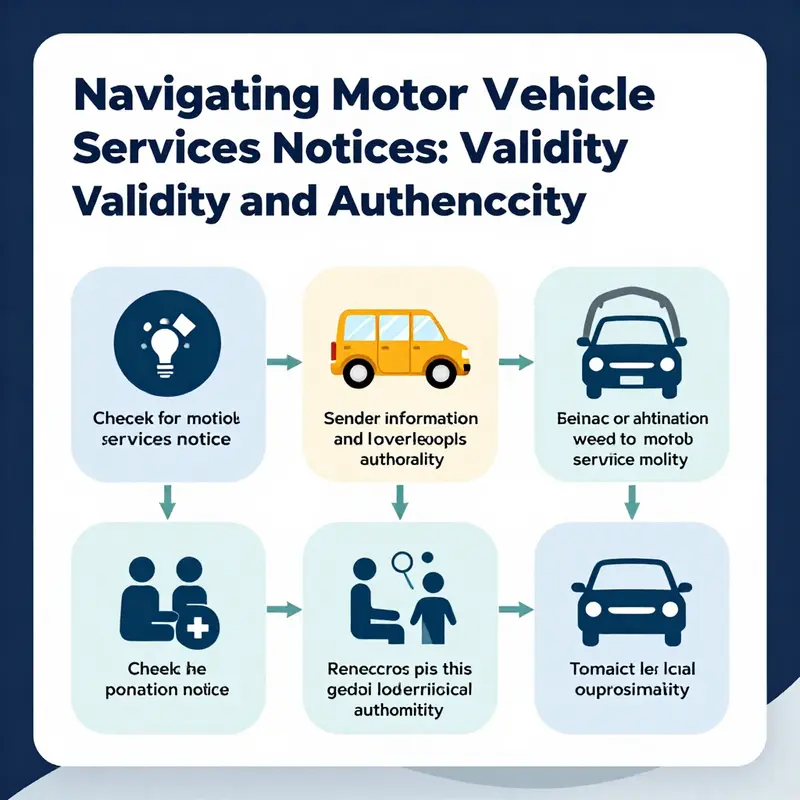
A reliable verification process usually unfolds in clearly defined steps. First, examine the sender carefully: does the email address or phone number align with known government domains or official service portals? Even if a domain looks plausible, small inconsistencies can reveal a spoof. Second, look for official branding cues beyond logos—case identification numbers, references to applicable state or national regulations, and the precise name of the agency involved. Third, treat links and attachments with suspicion. Hovering over a link can reveal its destination, and opening attachments from unsolicited messages can invite malware or fraud. Fourth, and perhaps most important, use verified official pathways to confirm the notice. This means going directly to the government’s own channel rather than replying to the message or calling numbers provided within it. Fifth, cross-check key details from the notice with information available through official portals—service types, processing times, eligibility criteria, and required documents. If anything does not match what you find on an official site, do not proceed. When in doubt, contact the agency through numbers or contacts published on its official website.
In the context of a country-wide framework, legitimate notices about motor vehicle services hinge on the existence of a central, authoritative source that consolidates procedures, timelines, and eligibility criteria. The principle is simple: the same platform that issues guidance and processes can also verify the notices that reference those processes. In the country under discussion here, the central authority maintains a Traffic Safety Comprehensive Service Platform. This platform is the primary repository for all information related to motor vehicle and driver’s license services. It is designed to provide up-to-date, authoritative guidance on registration, licensing, plate management, and related regulatory requirements. When you receive a notice that claims to originate from national or regional vehicle management services, you should first check whether its details align with what the platform shows about the service type, required documents, and processing times. If the notice contains a case number or a service identifier, you can confirm its validity by searching for that identifier within the platform’s official interface. In practice, this approach helps separate genuine notices from attempts to mislead or defraud by piggybacking on the authority of a recognized government system.
The platform itself is complemented by a centralized mobile interface that many citizens rely on for real-time interactions with vehicle management services. The official national traffic management app provides a direct line to the same service ecosystem, enabling users to apply for and track the status of services such as license-related actions, vehicle inspections, and other essential procedures. Because every transaction and inquiry lives within this controlled environment, the information you obtain through the app mirrors what the government records show. A notice that cannot be reconciled with entries in the app’s transaction history or with the platform’s current listings should raise a red flag. This convergence of channels—the central portal and the mobile interface—creates a robust verification framework. It allows users to confirm not only that a service exists but that the notice is part of a legitimate, ongoing process rather than a stand-alone or fabricated alert.
Local realities, too, matter. Each province or major city typically runs its own government services portal that integrates with national systems. These provincial portals provide localized details such as service locations, operating hours, and jurisdiction-specific procedures. They serve as official cross-checks when a notice references a service that may differ in its local implementation from a national template. The Zhejiang portal, the Shanghai portal, and the Beijing portal are examples of this localized layer of verification. A legitimate notice will ideally be consistent with what these portals present for the same service, including whether you need to visit a physical office, the documents required, and the expected processing timelines. If you live in a particular region, checking the provincial portal can be a quick way to confirm whether the notice aligns with local practice and to identify the correct contact channels for further inquiry. Taken together, the national platform, the official mobile interface, and provincial portals form a three-layer verification system that makes scams increasingly difficult to pull off and easier to detect.
For readers who want to connect verification with practical, everyday actions, consider how a legitimate notice should read against your prior experience with vehicle-related matters. A trustworthy notice will reference your existing records and the expected next steps in a manner that you can verify against your own files. It should specify the exact service you are seeking, the documents you must provide, deadlines, and the entity processing the request. If you recently updated personal information or had to renew credentials, a legitimate notice might reference these changes in a way that matches your recent activity on the official platform. When a notice claims to require payment, check whether the amount, the payment deadline, and the payment channel align with what the official platform shows for that service. Any discrepancy should prompt you to pause and re-verify through official channels rather than paying or sharing further data.
In addition to the structural cues of legitimacy, there are behavioral habits that can safeguard you from scams while keeping the verification process efficient. One habit is to rely on direct contact with the government body through numbers and emails published on the official site, not those provided in the notice itself. If the notice includes a phone number, you can verify it by checking the agency’s official contact page. If it provides a URL, you can compare it against the official portal’s link structure. Another habit is to avoid sharing sensitive information unless you are certain of the recipient’s identity and authority. Reputable processes never require you to disclose passwords or authentication details through insecure channels, and they typically provide secure methods for document submission, often through the official platform or sanctioned mobile applications. Finally, remember to preserve a record of the notice, including dates, identifiers, and a screenshot of the notice as received, until the matter is resolved through the official process.
For readers who want a practical touchstone beyond these guidelines, a quick note about resources you can consult visually without leaving your current page. Our broader vehicle safety and maintenance coverage includes ongoing references to official channels and verification practices. If you are seeking additional context on how notices intersect with routine vehicle ownership and safety checks, you can visit our blog for related discussions, which provides a broader view on keeping your vehicle documentation in order while staying compliant with regulations. kmzvehiclecenter blog.
Ultimately, a motor vehicle services notice is only as legitimate as its alignment with verified channels. If a notice can be reconciled with the central Traffic Safety Comprehensive Service Platform, with the national and provincial portals, and with the official mobile interface, you have a strong basis for trusting it. If any of these anchors don’t line up, treat the notice as suspicious and escalate through official contact points. This approach preserves the integrity of your records, protects you from financial loss, and keeps the process of vehicle management clear and transparent. When in doubt, rely on established checklists, consult the official platforms, and maintain a calm cadence in your response—these habits are the most reliable form of defense against fraud. For the most accurate and current verification, consult the authoritative resources available online via the national platform, the official mobile interface, and your provincial government portal, and visit the Traffic Safety Comprehensive Service Platform at https://gab.xuexi.cn for a consolidated, real-time reference.
Final thoughts
In conclusion, understanding the legitimacy of motor vehicle services notices is crucial for anyone engaged in vehicle ownership or management. By identifying the traits of legitimate notices, following verification steps, and acknowledging the risks of scams, local car owners, used car buyers and sellers, and small business fleet operators can safeguard themselves from potential fraud. Remaining proactive through the use of official resources and consistent vigilance can make all the difference in ensuring peace of mind. Stay informed, protect your interests, and navigate these notices with confidence.