Involving vehicle transactions, the Vehicle Services Division can be a maze of services and providers, both legitimate and potentially fraudulent. For local private car owners, used car buyers and sellers, and small business fleet operators, the importance of verifying the authenticity of a Vehicle Services Division cannot be overstated. This guide delves into critical aspects that help assess legitimacy, identify suspicious behaviors, and understand consumer rights and protections. Each chapter will equip you with the tools to navigate this landscape confidently, ensuring that you engage only with trusted and verified services.
Judging Legitimacy in a Complex Landscape: Is a Vehicle Services Division a Scam?
Evaluating the legitimacy of a Vehicle Services Division requires a disciplined, multi-source check rather than a single clue. The label alone does not prove authority or trustworthiness. In practice, start by clarifying whether the division is part of a government agency, a private provider, or a hybrid arrangement. Common government roles include vehicle registration, titling, licensing, and compliance oversight. A strong signal of legitimacy is an identifiable government portal, official contact points, and published processes with documented timelines and fees. If those anchors are missing or out of step with known government structures, proceed with caution.\n\nNext, verify the jurisdiction and governance. Look for official registry entries, a physical address, and multiple ways to reach the organization. Call a listed number from the government website and compare the responses with the information on the division’s site. When the entity claims government authority, corroboration through an official portal, press releases, or legal statutes is essential. If everything points to a government origin, the risk of misrepresentation is reduced, but not eliminated.\n\nPrivate providers can also operate legitimately in this space, offering help with document processing, scheduling, or reminders. The key brake on overreach is transparency: clear licensing or insurance statements, explicit service scopes, and no promises that exceed what is typical for vehicle maintenance and documentation. Be wary if the provider asserts unearned authority, demands payment up front without itemized pricing, or directs you to opaque channels for completion.\n\nA practical verification framework can help: verify the exact entity name and jurisdiction; confirm public registration or licensure; check for a physical address and official phone contact; review the stated service steps and required documents; and search consumer protection or regulatory bodies for any complaints or enforcement actions. When multiple independent sources align, the case for legitimacy strengthens; when sources conflict, treat with caution and seek direct confirmation.\n\nFinally, prioritize your safety and consent. If you feel pressured, see conflicting information, or encounter vague promises, pause and escalate to official consumer protection channels. Legitimate divisions typically provide clear warranties, channels for complaint resolution, and documented rights of recourse. That alignment between stated promises and verifiable governance is the best safeguard against scams while still allowing legitimate providers to operate alongside public bodies.
Spotting Fraud in Vehicle Services Divisions: Distinguishing Legitimate Government Services from Scam Tactics
Every time someone references a Vehicle Services Division, the immediate question in many readers’ minds is whether the term signals a legitimate government service or something less trustworthy. The short answer is more nuanced than a binary label. A Vehicle Services Division (VSD) can refer to a government department or to a private enterprise that offers vehicle-related services. The legitimacy of any given VSD, therefore, rests on jurisdiction, official status, and transparent operations rather than on the name alone. In some states, a VSD is embedded in a larger motor vehicle department, handling registration, titles, and licensing with systems designed to prevent fraud and to protect residents’ identities. In others, you may encounter private firms that use similar language to describe their service offerings. The critical task for consumers, practitioners, and policymakers is to distinguish the credible, process-driven operations from entities that leverage ambiguity to mislead.
To defend the public against wrongdoing, VSDs must be understood as complex ecosystems rather than single, monolithic entities. The legitimate divisions rely on clear procedures, documented verification, and a traceable chain of custody for documents and transactions. In many places, these functions are anchored in official websites that bear government domain names, official contact channels, and monitored complaint desks. The flip side is that fraudsters exploit public trust in these institutions. They imitate the language of officialdom, tailor messages to appear urgent, and threaten consequences that provoke quick, unclear, or reckless responses from wary citizens. This double reality—that legitimate service and calculated fraud share the same surface—makes vigilance essential and not optional.
An instructive pattern comes from well-documented external scams that target vehicle-related services. Reports describe scammers sending text messages that impersonate state DMVs, threatening license suspensions unless recipients act immediately. The messages often direct people to fraudulent websites or ask for personal data, creating a dangerous phishing vector. A notable example in mid-2025 highlighted that these kinds of incidents are not isolated events; they signal an evolving threat landscape that blends old-fashioned deception with modern digital outreach. Public agencies and security researchers warn that the more residents interact with online and text-based prompts, the higher the risk of data exposure. The NPR report from June 18, 2025 documents these patterns and underscores how these attacks ride on the public’s trust in official vehicle service channels. The takeaway is not to abandon digital services, but to strengthen them with robust authentication and user education so that legitimate channels remain less vulnerable and more transparent.
Within legitimate VSD operations, fraud risk is conceptualized as a combination of process weaknesses, data access vulnerabilities, and human factors. Early detection hinges on recognizing red flags that point to systemic vulnerabilities rather than isolated mistakes. For example, inconsistent or suspicious documentation can appear when a single person tries to juggle multiple applications across different databases. Patterns that emerge across records—such as a vehicle registered under different owners in separate jurisdictions, or duplicate titles being issued without a credible verification step—hint at broader manipulation. These signals are not proof of fraud on their own, but they should prompt deeper inquiry and cross-checks across systems. The existence of a fast-tracked case, especially when it bypasses standard verification or audit steps, can be equally worrisome. When it seems that someone inside the operation has more familiarity with particular applicants than is appropriate, this may indicate insider risk or targeted manipulation of the service pathway. Any combination of these signals should trigger a governance response, including targeted audits and enhanced oversight.
A central challenge is that fraud does not respect bureaucratic boundaries. When a vehicle’s ownership chain crosses jurisdictions, or when titles are issued or amended without a complete verification record, opportunists can exploit gaps between systems. The risk is magnified when insiders gain access to sensitive data or critical processing tools and are able to perform tasks outside normal workflow. In such cases, the indicators are not simply about one bad actor but about a pattern of access and activity that reveals a broader weakness in the control environment. Proactive defenses, therefore, demand not only software controls but people-centered measures. Real-time monitoring, strict access controls, and an auditable trail of every action are essential. Training programs that emphasize fraud awareness help staff distinguish routine customer requests from attempts to exploit the system. When employees understand the signs of fraud and are empowered to escalate suspicions, the organization becomes more resilient.
Operational resilience also requires collaboration beyond the walls of a single agency. Shared data sets, where privacy safeguards permit, can illuminate anomalies that would escape a lone department functioning in isolation. For instance, cross-agency data sharing can reveal inconsistencies across jurisdictions, catch duplicate records, and expose patterns indicating a coordinated effort to defraud multiple offices. Yet information sharing must be balanced with privacy rights and oversight to prevent accidental data leakage or retaliation against legitimate customers. The most effective defense combines technology with governance: automated checks that flag unusual activity, manual audits in response to risk signals, and a clear, public channel for reporting concerns. A culture of accountability—from leadership through frontline staff—reinforces the expectation that fraud will be detected and addressed, not ignored.
Residents who navigate vehicle services should be educated about how legitimate processes work and how to verify their status. Verification begins with the simplest steps: confirm you are using the official web address, and contact the agency through known channels rather than clicking on links from texts or emails. The official source will usually bear a government domain, and it will offer direct means of contacting a real customer service representative. When doubts arise, a prudent approach is to pause, verify, and consult multiple official sources. It is tempting to rush through a response when a message claims urgent action, but the cost of a wrong decision can be substantial, including loss of personal data and financial damage. The literature on consumer protection repeatedly emphasizes that legitimate public-facing organizations publish clear criteria for the services they offer, along with transparent pricing, expected timelines, and secure payment options. If those elements are missing, suspicion should grow, and further verification is warranted. For readers who want a concrete reminder of how to relate vehicle service knowledge to everyday maintenance practice, consider visiting a broadly useful resource about vehicle care. It can provide a baseline for what a legitimate service encounter should feel like, and it helps anchor the consumer to reliable, practical information. Truck maintenance tips for first-time owners.
The cautionary edges of this topic also demand that we recognize the limits of what a name can promise. The phrase Vehicle Services Division does not guarantee integrity or competence; it is a label that can be used by many different kinds of entities. In the best case, the phrase points to a legitimate public service with established safeguards and a public record of compliance. In the worst case, a label can be used to misrepresent a private enterprise or to lure victims into paying for services that are unnecessary or never completed. Distinguishing between those outcomes requires attention to jurisdiction, official channels, and tangible evidence of compliance. Consumers should check for the presence of licensing and insurance if a private business is involved, verify the professional credentials of staff, and examine the history of any complaints or disciplinary actions. Government agencies, by contrast, should provide verifiable contact details, maintain up-to-date online portals, and publish straightforward guidance on how to obtain essential services. These indicators are not a guarantee of perfection, but they are the practical tools people use to assess credibility.
Even as fraud awareness rises, the complexity of vehicle-related services will continue to challenge public trust. The convergence of digital communication, rapid service expectations, and cross-border data flows creates opportunities for both efficient service delivery and illicit manipulation. The NPR report underscores the need for robust verification systems and ongoing education for both staff and the public. It also highlights how scammers adapt to new digital channels, combining familiar government branding with persuasive inquiries designed to extract personal information. The message is clear: legitimate VSDs must stay ahead of fraud by investing in technology, training, and transparent, user-friendly communications, while the public remains vigilant and informed. By maintaining strong governance, clear procedures, and responsive support, VSDs can deliver essential services without becoming unwitting enablers of crime.
Ultimately, the central question remains: is a Vehicle Services Division a scam? The answer is not a categorical yes or no; it is a matter of how well a given division defends against fraud, how transparently it operates, and how clearly it communicates with the people it serves. The difference between a trusted, well-led government service and a fraudulent scheme often lies in the discipline of the operation. The signs of a credible VSD include a public, verifiable presence, consistent documentation across systems, and a history of measured, auditable processes. Conversely, what looks like a scam—persistent pressure for upfront payments, inconsistencies across data, or a reliance on informal channels with weak verification—should raise alarms and trigger a careful recheck. The public’s job is not to distrust every notification they receive, but to demand evidence, to ask questions, and to use official, corroborated sources for every action. When institutions are accountable, and the public remains informed, the line between legitimate service and fraud becomes clearer and easier to defend.
For further reading, see NPR’s report on the evolving threat landscape for vehicle service scams: Nationwide DMV Scams.
Guardrails on the Road to Vehicle Service Fairness: Rights, Protections, and How to Spot Scams in the Vehicle Services Division
When people hear the term Vehicle Services Division, they often imagine a single, trustworthy gatekeeper that either safeguards consumers or, in the wrong hands, becomes a path to fraud. In reality, the phrase covers a spectrum. It can name a legitimate government department that handles vehicle registration, titling, and licensing; it can also be a descriptor used by private businesses, sometimes with legitimate offerings and other times with questionable tactics. The key to understanding whether a specific Vehicle Services Division is legitimate or a scam lies in context, jurisdiction, and the details of the interaction. A savvy consumer navigates this landscape by distinguishing official government functions from private service vendors, scrutinizing verifiable credentials, and anchoring decisions to credible sources. In many places, the official vehicles division of a state or locality operates under a government domain and carries out tasks essential to daily mobility: registration, title issuance, driver’s license services, and the maintenance of records that prove ownership and eligibility to operate on public roads. The California example, widely cited in consumer guidance, demonstrates how a government vehicle services department can deliver stable, transparent services when accessed through a verified government portal. The official site ends in a .gov domain, a simple but powerful cue in the digital age that helps prevent confusion with private entities that might use similar branding to imply authority. The fundamental lesson is clear: always start with the jurisdiction, then verify the exact name and the agency’s role within that jurisdiction. A misalignment between the name you encounter and the recognized governmental structure is a strong signal to pause and investigate further. A formal lookup, ideally through the state’s own portal, is the safest first step. For most readers, this means confirming that the domain is government-operated and checking that the service you seek aligns with the agency’s published scope. Beyond websites, legitimate divisions publish contact information that can be cross-checked against official directories, and they offer consistent channels for communication, whether by mail, phone, or in-person visits at recognized government facilities. The temptation to treat a high-pressure call or an unsolicited email as routine can be dangerous. Scammers often mimic official wording, use urgent language, or demand upfront payments for services with unclear scope. The most telling signs are the absence of official contact details, a lack of a traceable address, and requests for sensitive information or payment before any legitimate service is provided. In short, the road to protection begins with rigorous verification, not quick conclusions. A careful approach recognizes that government divisions exist to facilitate access and ensure accuracy in records that underpin one’s ability to drive legally, transfer ownership, and maintain roadworthiness. When the interaction remains squarely within a government channel, the process is often straightforward: you provide needed documents, the division validates them, and you receive clear receipts and confirmations. The simplicity of this model is precisely what makes misrepresentation so dangerous. If a caller or emails you with a mix of ambiguity and urgency, urging you to act before you can verify the source, that is a red flag worth noting and documenting. The consumer experience thus becomes less about fear and more about methodological caution. In this framework, the real risk lies not in the existence of a Vehicle Services Division per se but in the murk surrounding certain dealings attributed to that name. A private firm may offer services that resemble official functions—title transfers, vehicle inspections, even registration assistance—but if the provider is not properly licensed, insured, or transparent about fees, the risk of being scammed rises sharply. To guard against this, a practical mindset is essential: verify the provider’s licensing and credentials, demand itemized estimates, and insist on written terms that spell out warranties, timelines, and the exact services to be performed. It is here that consumer rights become a powerful shield. The right to information is foundational. It means you deserve a full explanation of what a service will include, what it will cost, what documents are needed, and what warranties cover the work. In vehicle transactions, warranties can be express, clearly promised in writing or advertising, or implied, arising by operation of law to protect a buyer against poor workmanship or misrepresentation. The express warranty is the bright line—the dealer or repair provider promises a particular performance for a defined period, often stated in terms such as a certain number of months or miles and enumerating specific components. The implied warranty of merchantability ensures that the vehicle is fit for ordinary use, and the implied warranty of fitness for a particular purpose covers situations in which the buyer relies on a seller’s expertise for a special need. These safeguards, while essential, require a proactive stance from consumers. A crucial habit is to document every agreement and interaction. Keeping copies of emails, text messages, quotes, service orders, and receipts creates a trail that can be reviewed if a dispute arises. Documentation helps both sides understand what was promised and what was delivered. It also serves as critical evidence when reporting suspicions of fraud. When confronted with a request for upfront payment for ambiguous services, or with a tone that pressures you to act immediately, the prudent response is to pause, request a written estimate, and verify the credentials of the provider. In a legitimate setting, the estimate should be broken down into parts: diagnostic fees, parts, labor, and any potential add-ons. The language should be precise, avoiding vague phrases that could conceal unnecessary work or inflated costs. The difference between a credible offer and a predatory one often lies in the specificity of the language and the presence of a signed agreement before any work begins. The broader consumer protection system in the United States relies on multiple pillars. At the federal level, the Federal Trade Commission monitors and enforces consumer protection laws, including those that apply to auto sales and repairs. The FTC’s consumer education materials emphasize the importance of recognizing red flags, such as pressure tactics, ambiguous warranties, and requests for payment for services the consumer did not approve. Meanwhile, state attorneys general can address violations that are unique to local markets, potentially offering remedies like the right to rescind contracts or to receive compensation for improper practices. In practice, this multi-layered structure means a consumer who suspects a scam has a clear path for recourse: gather documentation, file a complaint with the FTC, and contact the state attorney general. The process can be more efficient when the consumer can demonstrate that the provider misrepresented services, charged for work not performed, or failed to meet the terms of a warranty. The social and digital trails—reviews, forums, and consumer protection agencies—also play a role in shaping the risk landscape. A routine search for a shop’s name, its licensing details, and customer reviews can reveal patterns or repeated complaints. It is important to separate legitimate criticism from online misinformation, which makes cross-referencing credible sources essential. In this light, consumer education becomes not only a personal shield but a public good. The practical steps are straightforward and repeatable. First, start with verification: confirm that you are interacting with a government division if your objective is a government service, such as title transfers or driver’s license duties. If a private company is involved, ensure it holds the appropriate licenses and insurance for auto repair and related services. Second, insist on transparent pricing and a written scope of work. Ask for an upfront diagnosis that is then locked into a formal estimate, with an explicit approval required before any additional work is performed. Third, compare warranties. Understand the duration and breadth of coverage, what components are protected, and whether there are exclusions or maintenance requirements that could void coverage. Finally, when in doubt, lean on the official channels. For readers seeking more detailed, consumer-focused guidance, the FTC offers authoritative information on automobile scams, including common schemes and practical steps to protect yourself. This external resource provides broader context about the kinds of tactics used by fraudsters and the rights consumers retain when they encounter suspicious activity. A responsible approach to vehicle services combines curiosity, caution, and a respect for verified sources. It recognizes the legitimacy of government divisions while also acknowledging that the market includes private players who may offer legitimate services alongside high-risk practices. The testing ground for trust, in other words, is not a blanket judgment about the phrase Vehicle Services Division but a careful, informed assessment of who is providing the service, under what authority, and with what promises. For those who want a consolidated reservoir of practical guidance, the KMZ Vehicle Center blog can serve as a helpful companion. It aggregates maintenance insights and consumer-facing guidance in a way that complements formal protections. Readers can explore more about vehicle maintenance, service expectations, and best practices on the KMZ Vehicle Center blog. KMZ Vehicle Center blog. This internal resource, while not a substitute for legal or regulatory advice, can help readers develop a disciplined approach to understanding service needs, timing, and cost expectations, which in turn supports wiser decisions when dealing with any Vehicle Services Division, whether it is a government agency or a private provider. The overarching message is that consumer rights in vehicle services are not abstract privileges but practical protections that enable fair treatment and reliable outcomes. The more you know about warranties, transparent pricing, and verification standards, the less room there is for predatory practices to take root. And when a situation does escalate, the combination of careful documentation, credible information sources, and established complaint channels empowers you to pursue remedies effectively. The journey from curiosity to confidence in this space is not instantaneous, but it is methodical. It mirrors how responsible consumers navigate any complex service ecosystem: ask the right questions, verify the authority behind the service, document every step, and lean on established consumer protection mechanisms when necessary. In the end, the question is not whether vehicle services divisions can be scams in all cases, but whether the specific arrangement you encounter has the hallmarks of legitimacy, transparency, and accountability. When these hallmarks are present, the experience can be smooth and predictable, enabling you to focus on what matters most—keeping your vehicle safe, compliant, and reliable. When they are absent, vigilance remains your strongest ally. If you encounter opaque practices, unverified claims, or pressure to pay upfront for unclear work, you are well within your rights to step back, seek clarification, and report concerns. In this sense, consumer rights and protections function as a framework not only for safeguarding money but for preserving trust in the broader system that keeps people on the road with confidence. As you navigate these waters, remember that verification, documentation, and recourse are not burdens but essential tools. They transform a potentially risky encounter into a controllable process with measurable outcomes. And they help ensure that the Vehicle Services Division, in whatever jurisdiction or form it appears, serves the public good rather than becoming a pathway to exploitation. For ongoing guidance and further reading, keep the door open to credible resources, including official government disclosures and trusted consumer education platforms. The aim is to empower you to make informed, deliberate choices every time you engage with any service that touches the critical functions of vehicle ownership and operation. The road to fair treatment is built on careful steps, justified expectations, and a clear understanding of your rights as a consumer navigating the sometimes murky terrain of vehicle services. External references are valuable touchpoints in this journey, offering perspectives and procedures that complement personal vigilance. For more structured guidance about how to recognize and respond to automobile scams, consult the FTC’s detailed consumer education resource at https://www.consumer.ftc.gov/articles/0142-automobile-scams. This site outlines common fraud patterns and practical steps to protect yourself, reinforcing a prudent approach to any interaction that involves vehicle-related services and documentation.
Tracing the Truth: Recognizing and Reporting Suspected Vehicle Services Division Scams
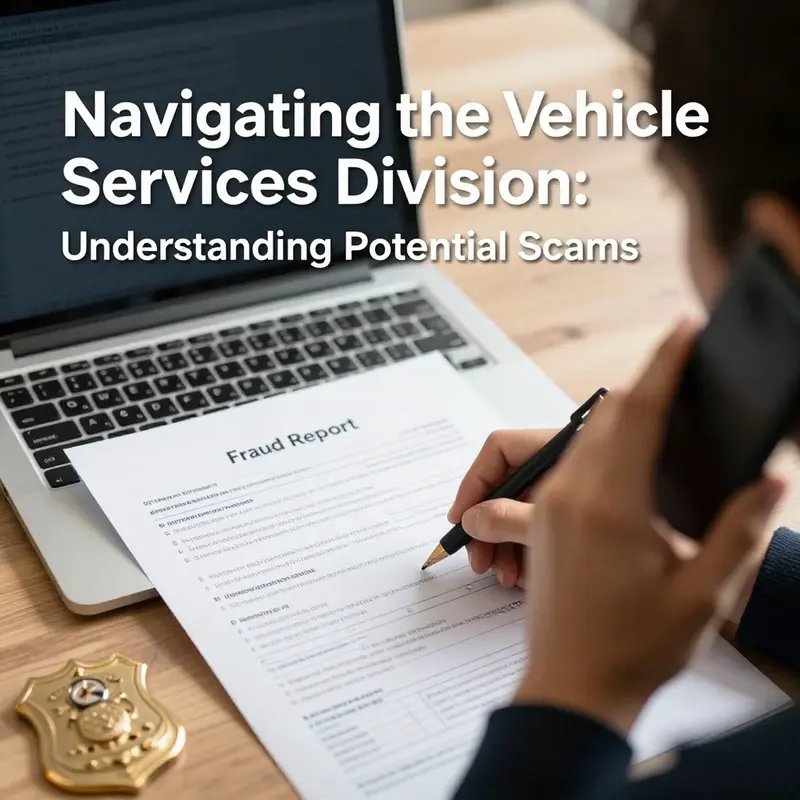
When people encounter a phrase like Vehicle Services Division, the mind can drift between official bureaucracy and a dubious pitch dressed as authority. In the real world, the term can refer to a legitimate government unit that handles vehicle registration, titles, and licensing, or to a private firm that uses similar branding to project legitimacy. The question “is vehicle services division a scam?” does not have a universal yes or no. It depends on which entity you are dealing with, how the communication arrives, and whether the organization is properly registered and transparent. The chapter that follows seeks to unravel that distinction by tracing through the signals a reader can use to discriminate between legitimate service, misdirection, and outright fraud. In this landscape, knowledge is not a luxury but a protective tool, because scammers thrive when complexity seems to shield them from scrutiny. A careful reader learns to slow down, verify credentials, and keep crucial boundaries intact—especially when money or sensitive information is at stake.
Legitimate contexts for the Vehicle Services Division tend to share a common backbone: official authority, identifiable public service objectives, and traceable governance. In many states, a Vehicle Services Division operates as a department within a larger transportation agency or a state’s department of motor vehicles. Its core tasks—vehicle registration, titling, driver’s licensing, and the issuance of official documents—are transactional, procedural, and usually bound to regulatory frameworks. When these services interact with the public, the communication channels typically reveal themselves as stable, predictable, and anchored in public infrastructure. A government site will usually carry a .gov domain, a physical mailing address, and a verifiable customer service pathway. This is not a guarantee against misuse by private actors, but it is a baseline reality that scammers often fail to mimic convincingly. The integrity of a legitimate government service rests on transparency: clear fees, published processing times, a public complaint mechanism, and a way to verify the exact jurisdiction and name of the agency involved. In contrast, a private company or an entity with unclear branding may lack these hallmarks, offering instead a glossy pitch, a sense of urgency, or a reward for immediate action. The difference matters because the same phrase—Vehicle Services Division—can point to two entirely different realities depending on who stands behind it.
To understand where the risk begins, consider the patterns that frequently appear in scams that revolve around vehicle services. Scammers often impersonate government officials or agents of a vehicle service center, using badges, titles, or official-sounding IDs. The tactic is simple yet effective: leverage assumed authority to elicit trust and compress the decision window. Messages and calls arrive with an air of inevitability—an urgent deadline, a warning of imminent penalties, or a request to “verify” information immediately. The submission of documents or the transfer of funds is framed as a prerequisite to avoid loss or to restore access to a vital service. The emotional push is deliberate: fear of late fees, fear of losing driving privileges, or fear of a looming suspension. These are classic opening moves designed to lower skepticism and raise compliance. A second pattern involves payment methods that feel unusual for government processes—requests for wire transfers, prepaid cards, or third-party payment apps that bypass standard accounting trails. A third common signal is inconsistency in branding: emails or calls that reference a Vehicle Services Division but use a non-official domain, a misspelled government name, or contact information that cannot be independently verified. While none of these indicators alone confirms a scam, together they form a composite that should prompt caution and verification.
The verification process in these moments is not a trap but a practical safeguard. A legitimate government service, even when accessed remotely, will provide official channels that can be cross-checked. The most reliable first move is to locate the official agency site through trusted means rather than following a link embedded in a suspicious message. If you suspect you are dealing with a Vehicle Services Division, compare the contact information given in the communication with the official directory published by the state’s transportation department. If a government voice claims to be from the Vehicle Services Division but does not provide a direct, verifiable way to reach a real office, that is a strong warning sign. The domain itself is a clue: .gov domains are required for official federal and many state government sites in the United States. State agencies will often publish the exact name of the division in bold, with a disclaimer about official communications and a published policy on fees and deadlines. The absence of these elements does not prove fraud on its own, but it heightens the need for careful verification.
Once you turn on the lens of scrutiny, you begin to see a broader set of protective habits that apply beyond merely the confirmation of a single identity. A crucial habit is to pause before sharing sensitive information. Government services require personal data, but they do not rely on pressure to capture it. If a caller asks for your full social security number, bank details, or a scan of documentation through an unencrypted channel, the request should be treated as a red flag. Legitimate processes typically require identity verification in controlled, documented ways, not through sudden, off-platform exchanges. Another protective habit is to document every interaction. Save emails, take screenshots, record dates and times of calls, and note the names of any representatives who claim to be part of a Vehicle Services Division. This documentation becomes invaluable if you decide to report the incident or pursue a complaint with an official body.
The practical steps for someone who suspects a scam are straightforward but not trivial in the moment of tension. If you suspect that you have encountered a Vehicle Services Division scam, begin by stepping back from any immediate action that would involve payment or the disclosure of sensitive information. Do not provide financial details or copies of documents until you have corroborated with an independent, official source. The next step is to verify the identity of the entity through trusted, public channels. A direct way to do this is by visiting the official state or federal government website or calling a known, published number for the agency, rather than using any phone number provided in the suspicious communication. If the same number or entity appears inconsistent with the government’s own records, you should treat it as potentially fraudulent. A helpful heuristic is to search the agency name together with the word “fraud” or “scam” to see if there are alerts or consumer advisories associated with that name. Consumers frequently report that scammers will clone or closely mimic legitimate names—hence the necessity of independent verification.
In the realm of action, there is a practical, historically effective route for accountability. Reporting suspected scams protects not only the individual but also the broader community by allowing authorities to identify patterns and slow the scammers’ momentum. In the United States, the Federal Trade Commission (FTC) maintains a fraud reporting framework that accepts online complaints. Submitting a detailed report helps law enforcement agencies track fraudulent activity and may prompt further investigations. If a scam involves identity theft or financial fraud, additional channels such as the Internet Crime Complaint Center (IC3), operated by the FBI, should be considered. Each reporting path has its own scope and is designed to capture different facets of the wrongdoing, from deceptive business practices to cyber-enabled crimes. The act of reporting also supports the larger social objective of building a safer digital environment. When individuals share their experiences in a structured, official format, it becomes easier for investigators to notice trends, issue warnings, and intervene where necessary.
A practical aspect of reporting is accuracy and completeness. When you file a report, include the exact wording of the message, the date and time you received it, the contact details offered, any attachments or links, and a narrative that explains how you interacted with the entity. If you have already provided information or paid fees, outline the steps you took to mitigate harm and whether you secured copies of any documents. If possible, preserve the original communications in their intact form. These details not only assist investigators but also help consumer protection agencies issue timely guidance to the broader public. Moreover, reporting is a civic action that reinforces the accountability of entities operating within or adjacent to government services. The more incidents that are documented, the stronger the signal to regulators that preventive measures are required.
Verification remains a central theme throughout this chapter. It is not enough to recognize that a message seems legitimate; one must confirm it by cross-referencing with the authoritative sources of the agency involved. If you cannot locate a clear, official path to verification—an official government domain, a publicly listed contact channel, an unambiguous proof of licensing for a private service—treat the situation as suspicious. When the stakes involve your personal information and your ability to access essential services, the safest course is to err on the side of caution. It is not paranoia to seek a second opinion from trusted public sources. In many cases, a legitimate Vehicle Services Division will be transparent about how it can be reached, what documents are needed for specific transactions, what fees apply, and how long each step should take. If any of these elements appear vague, inconsistent, or aimed at pressuring you into rapid action, that is a cue to disengage and verify.
Within this framework, consider the broader ecosystem of vehicle services on which legitimate operations rely. Private maintenance and service providers may share a common audience with government agencies when customers need titles, registrations, or inspections tied to vehicles. In such cases, the line between legitimate private service centers and scams can blur, particularly for individuals who are new to vehicle ownership or unfamiliar with the local regulatory landscape. The best shield remains a robust sense of how official processes ought to feel: the calm, methodical cadence of official communication, the presence of verifiable licensing, and the absence of pressure tactics. If you are unsure, you can always consult public resources or reputable consumer guidance before you proceed. The objective is not to deter legitimate transactions but to ensure that legitimate interactions remain accessible and free from predatory practices.
For readers seeking practical examples and additional context on vehicle care and legitimate service practices, the KMZ Vehicle Center blog serves as a resource that distinguishes genuine maintenance information from misleading claims. Within the broader conversation about vehicle services, understanding maintenance expectations can reduce the likelihood that a consumer misinterprets legitimate communications as scams. This broader literacy—knowing what proper service looks like and where to find trustworthy guidance—strengthens one’s ability to assess any message that uses the Vehicle Services Division label. To explore practical maintenance insights that stay well within legitimate boundaries, readers can visit the KMZ Vehicle Center blog, which provides a hub of information on proper care and maintenance practices. KMZ Vehicle Center blog.
The chapter ends, not with a final decree about the phrase itself, but with a durable approach to discernment: treat any message that claims to be from a Vehicle Services Division as potentially legitimate only after you have verified through official, primary sources; never surrender personal or financial information before that verification; document everything; and report suspicious activity through trusted national channels when verification fails. This approach preserves access to essential public services while continuing to guard against misrepresentation. By adopting a routine of verification, documentation, and timely reporting, individuals contribute to a broader culture of vigilance that helps police, regulators, and consumer protection agencies identify and interrupt scams before more people become victims.
External resource: for further guidance on reporting suspected fraud, visit the FTC at https://www.ftc.gov.
Final thoughts
Understanding the nuances of the Vehicle Services Division and being able to identify potential scams is essential for any consumer involved in vehicle transactions. This guide outlines how to assess legitimacy, recognize fraud indicators, know your rights, and take action when fraud occurs. Adopting a proactive approach ensures that you are equipped to navigate this space confidently, making informed decisions about your vehicle-related interactions.