With the growing demands of today’s automotive landscape, car owners, dealers, and small businesses seek convenient, high-quality vehicle maintenance. A. Anthony’s Mobile Vehicle Service, Inc. addresses this necessity with expert mobile services, drawing on decades of experience and ASE-certified professionals. This article delves into the company’s history, the extensive services they offer, their adherence to high standards and certifications, and the positive impact they have on the community, underscoring their commitment to customer satisfaction and community well-being.
Bringing Expert Auto Care to Your Doorstep: The Story and Service Model of A. Anthony’s Mobile Vehicle Service Inc.
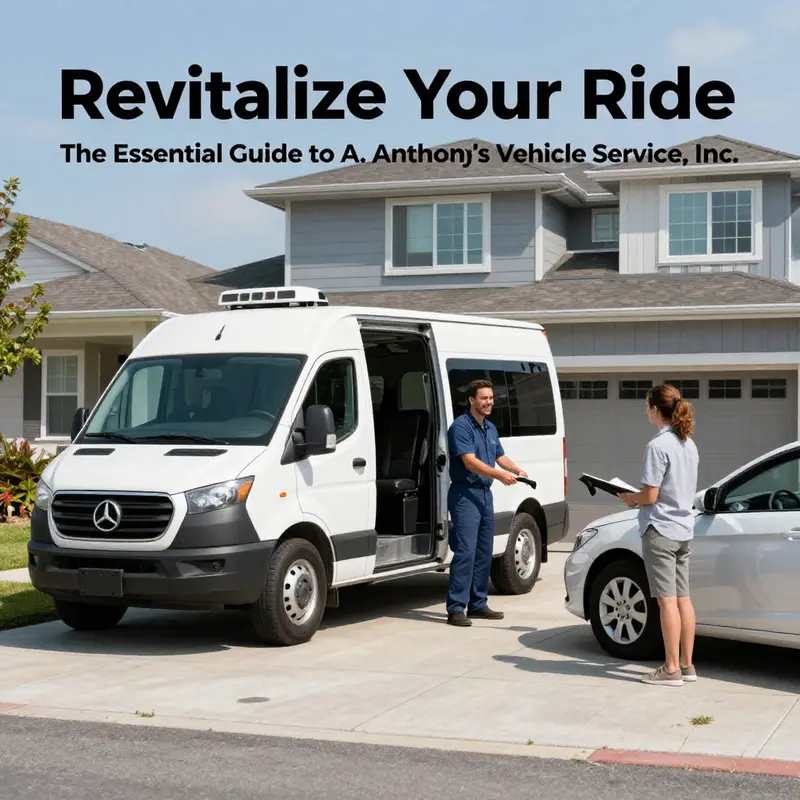
A. Anthony’s Mobile Vehicle Service Inc. stands as a distinctive thread in the fabric of automotive care, not merely because it travels to a client, but because it embodies a philosophy that treats vehicle maintenance as a personal service rather than a transactional repair. Founded in 1988 by Mr. Anthony DonBullian, the company grew from a recognition that time, reliability, and trust matter as much as the quality of the work itself. What began as a response to the universal inconvenience of bringing a car to a shop has evolved into a robust, trusted model that delivers professional care precisely where customers need it: at their homes or workplaces. The core idea has remained constant since those early days: technicians who bring decades of hands-on experience, portable equipment, and a commitment to high standards, right to the client’s driveway or parking lot. This approach has not only redefined convenience but has elevated expectations about what mobile automotive service can be when the technician is an ASE-certified professional with a broad and rigorous skill set.
From the outset, the emphasis was on expertise. Mr. DonBullian built a team around the idea that automotive service should be accessible without compromising on competency. His decision to pursue and maintain ASE certification across all eight categories recognized by the National Institute for Automotive Service Excellence was not merely a credentialing exercise; it signaled a promise to customers that the people working on their vehicles possess a comprehensive and tested breadth of knowledge. In an industry where prestige can sometimes be inferred from equipment or speed, the ASE framework anchors trust in demonstrable capability. It assures clients that the technician can diagnose, repair, and maintain modern vehicles to a professional standard, whether they arrive with a toolbox, a diagnostic scanner, or a set of specialty hand tools tailored to a specific job.
The mobile service model described by the company’s offerings is more than a mere convenience; it is a response to the logistics of daily life. For many vehicle owners, arranging a ride to a shop, coordinating a pickup and drop-off, and juggling a work schedule can be a significant burden. A. Anthony’s Mobile Vehicle Service Inc. addresses this friction by bringing routine maintenance and essential safety checks directly to the customer. The service repertoire is deliberately practical and targeted toward preserving vehicle performance and safety without requiring the client to disrupt their day. This alignment of purpose and logistics—high-quality work delivered on site—creates a sense of continuity between the car and its owner that is often lacking in traditional repair journeys. It is a model built on the understanding that a vehicle is not just a machine relegated to a garage but a trusted companion that supports work, family life, and personal milestones.
The narrative of the company’s services is anchored in a handful of core offerings that together form a comprehensive maintenance philosophy. Routine maintenance, including oil changes and tire rotations, is paired with fluid checks and comprehensive safety inspections. Each of these tasks is chosen with the on-site capability in mind, leveraging portable equipment and the technician’s expertise to deliver precise work in a practical setting. The emphasis on safety inspections underscores a broader commitment to proactive care rather than reactive fixes. By checking braking components, lighting, suspension, tires, and fluid levels in a single, well-structured visit, the technician helps customers identify wear patterns, anticipate components nearing the end of their service life, and establish a plan that minimizes the risk of breakdowns. The result is not only safer vehicles but improved long-term reliability, which is especially valuable for fleets and busy households that rely on dependable transportation.
In describing the service experience, the presence of courteous, communicative technicians emerges as a throughline. It is not enough to perform precise mechanical work; the interaction with the client matters just as much. The company’s emphasis on courteous service translates into clear explanations of what is happening during the visit, transparent assessments of what maintenance or repairs are recommended, and thoughtful scheduling that respects the client’s time. This human-centered approach—paired with professional proficiency—creates a relationship built on trust. Customers come to expect not only the technical competence of the person working on their car but also the reassurance that their vehicle will be treated with respect and care in the very place they trust most: their home or workplace. The pricing philosophy mirrors this commitment to value. By offering reasonable pricing for a mobile service, the company makes high-quality, ASE-backed expertise accessible without a premium that discounts the importance of the service. The result is a practical, dignified approach to vehicle maintenance that does not force a customer into a conventional shop environment simply to receive good care.
The narrative of this service model naturally invites reflection on how mobile automotive work intersects with broader industry trends. The shift toward on-site maintenance aligns with evolving expectations about convenience, time management, and safety. Modern vehicles require more sophisticated diagnostics and more meticulous maintenance schedules, but they do not always require customers to surrender a full day to a shop floor. The mobile model recognizes that the work can be done efficiently in the client’s environment when the technician arrives with the right tools and the right plan. It also dovetails with a growing emphasis on preventative care and transparency in vehicle upkeep. Rather than waiting for a breakdown, owners are encouraged to adopt a proactive mindset—conducting routine checks, addressing wear and tear before it escalates, and setting up maintenance calendars that maximize the lifespan of components and the overall value of the vehicle.
The founder’s vision is reinforced daily by the operation’s emphasis on reliability and skill. The eight-category ASE certification is not a symbolic credential but a practical guarantee that the technician can navigate the complexities of modern vehicle systems. As vehicles have advanced, so have the expectations for service professionals who diagnose issues ranging from basic wear to more nuanced electronic and sensor-related concerns. A. Anthony’s Mobile Vehicle Service Inc. positions itself as a bridge between traditional automotive craft and contemporary service models. It embodies the idea that staying current with technology does not necessitate a fixed location; instead, it requires a mobile capability, a well-trained technician, and a system for delivering consistent, high-quality outcomes wherever the customer happens to be.
The chapter’s focus on convenience should not obscure the attention paid to workmanship. On-site care demands meticulous preparation: portable diagnostic devices tuned to detect a spectrum of conditions, the ability to perform essential procedures in a non-stationary setting, and a disciplined approach to waste management and safety. The commitment to high standards of workmanship stays visible in the daily practices of the team. Whether a visit involves a routine oil change or a more involved safety inspection, the same principle applies: thoroughness, clarity, and accountability. Customers receive a clear explanation of what was checked, what was found, and what steps should follow, enabling informed decisions about maintenance timelines and any necessary next steps. In this sense, the mobile service functions not as a shortcut but as an extension of the same careful, methodical approach customers would expect from a stationary shop, delivered in a way that respects the client’s time and surroundings.
A practical cadence emerges from this approach. Home and business environments demand efficiency, and the mobile model translates this into appointments that minimize disruption while maximizing value. The technician’s arrival is not a disruption—it is a streamlined, organized service encounter in which the vehicle is treated as a shared responsibility between owner and professional. The emphasis on safety remains central: the technician adheres to safety standards, performs thorough inspections, and communicates findings in plain terms. This ongoing dialogue helps customers develop a longer-term plan for their vehicle’s health, shifting maintenance from a reactive reaction to a coordinated, proactive program. It is a shift that extends beyond a single visit and informs future decision-making about service intervals, inspection frequency, and the allocation of maintenance budgets across the vehicle’s lifespan.
For readers who want to explore practical, related guidance on maintenance intervals and preventive care while keeping in mind the realities of time and mobility, the KMZ Vehicle Center blog offers a wealth of context. One particularly relevant piece discusses oil-change intervals and the balance between time-based and mileage-based recommendations. It provides a user-friendly framework for thinking through when maintenance is due, what signs to watch for, and how to align service plans with driving patterns. You can read more at the article on optimal oil-change intervals: time vs. mileage.
As the broader automotive landscape continues to evolve, the story of A. Anthony’s Mobile Vehicle Service Inc. serves as a case study in how service models adapt to changing expectations without compromising craft. The combination of founder-led expertise, a commitment to on-site care, and an emphasis on courteous, transparent work creates a compelling template for future mobile automotive services. It is a reminder that quality care can travel with the customer and that the most meaningful innovations in service come not from flashy features or expensive hardware, but from the persistent pursuit of reliability, respect, and real value in every visit. This approach resonates with both individual vehicle owners and fleets alike, offering a dependable solution for keeping wheels turning with confidence.
External resource: https://www.anthonysmobilevehicleservice.com
On the Move for Your Car: How Anthony’s Mobile Vehicle Service, Inc. Redefines On-Demand Auto Care
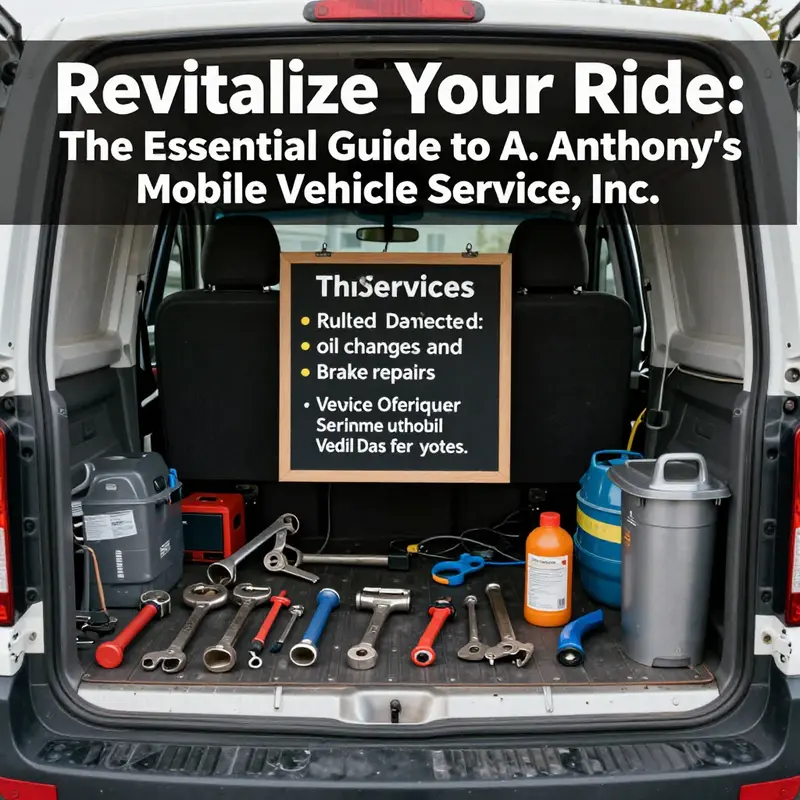
A. Anthony’s Mobile Vehicle Service, Inc. began its journey in 1988, not as a shop with doors, but as a promise to bring expert care directly to customers wherever their cars needed attention. The founder, Mr. Anthony DonBullian, built the company around a simple principle: reliable automotive service should be convenient and respectful of a customer’s time. From the outset, the business embraced a mobile model that would later become a hallmark of the industry, proving that high-quality maintenance and repair can happen beyond the four walls of a traditional repair bay. This chapter explores how that early insight matured into a robust service offering, anchored by Mr. DonBullian’s own credentials and a team of professionals who share his commitment to craftsmanship, courtesy, and clarity in every encounter with a vehicle and its owner. The narrative is not only about what is offered but why those offerings matter—how they fit into a broader narrative of trust, accessibility, and consistent value in auto care.
At the core of the company’s credibility is the technician’s standing: an ASE-certified professional who holds certifications across all eight categories recognized by the National Institute for Automotive Service Excellence. This breadth of certification is more than a badge; it signals a deep, validated knowledge base that underpins every on-site visit. When a technician arrives with a full spectrum of training, customers gain more than reassurance. They gain the confidence that comes from knowing the person under the hood is equipped to diagnose issues accurately, suggest appropriate solutions, and execute with skill. Those eight ASE categories map to a capability set that covers the essential systems of most passenger vehicles and light-duty equipment. It means the technician can navigate electrical diagnostics, engine performance, steering and suspension concerns, braking systems, and routine maintenance with a coherent framework. In practice, this translates to efficiency on the road and fewer surprises in the driveway, which matters when a family schedules a maintenance window, or a fleet manager needs deadlines met without the downtime typical of a multi-point service visit.
The decision to specialize in mobile service is not merely about convenience. It is also about aligning service delivery with the lived realities of customers. Many drivers juggle tight schedules, demanding work commitments, or caregiving responsibilities that make a trip to a shop a burdensome obligation. A mobile service model flips the script. It allows the technician to work within the customer’s preferred setting—at home, at the office, or at a site that minimizes disruption to daily life. The service ethos here blends practicality with professionalism. Technicians arrive not only with a well-stocked toolkit but with a mindset of courtesy and respect for the client’s time, property, and routine. The aim is to be unobtrusive yet thorough, to deliver transparent information, and to complete the work with minimal intrusion while maintaining the highest standards of quality.
When the company speaks of services offered, it speaks of a breadth of on-site capabilities that covers preventive maintenance, diagnostics, and timely repairs. On the maintenance side, the on-site model supports routine checks and tune-ups that can prevent minor issues from becoming major costs. That includes systematic fluid checks, filter evaluations, tire health assessments, brake wear considerations, and battery condition monitoring. The emphasis is on preventing wear and tear from accelerating, not merely reacting when a warning light glows. The diagnostics side is equally robust. Modern vehicles rely on intricate computer systems that communicate through sensors, modules, and data streams. A mobile technician with strong diagnostic training can interpret fault codes, perform live data analysis, and conduct functional tests on components in real-world conditions. Where a shop might pull a vehicle into a bay for a diagnostic session, the mobile approach keeps the car accessible in its usual environment, reducing the risk of miscommunication about symptoms that can occur when a vehicle is moved multiple times. The result is a more precise understanding of what a vehicle truly needs and a plan that minimizes unnecessary replacements while targeting the root cause.
A paragraph about the practicalities of service helps illustrate how the model translates into everyday benefits. Scheduling is designed to be straightforward, with clear windows and reliable arrival times. When the technician appears, the first step is a careful, on-site inspection that respects the vehicle owner’s time and the car’s current state. The technician explains the findings in plain language, avoiding jargon, and presents options that align with the customer’s budget and goals. This approach helps establish a shared understanding of what is necessary now and what can be scheduled for later, a critical distinction when the vehicle is essential for family logistics or business operations. Pricing is described as reasonable and transparent, a feature that reassures customers who may have faced unexpected costs in the past when visiting a traditional repair shop. The emphasis on fair pricing is not just a pledge; it is reinforced by providing itemized estimates and a clear rationale for each recommendation. The customer is invited to approve or adjust the plan before any work begins, reinforcing a sense of control and partnership in the service relationship.
The personal touch is an enduring feature of Anthony’s mobile service. The technicians carry themselves with professionalism and courtesy, recognizing that a repair person arriving at a home or workplace becomes part of that environment for the duration of the visit. The service team understands how to communicate with different types of customers—parents juggling car seats, professionals racing between meetings, seniors who value dignity and patience, and owners who want straightforward, no-nonsense guidance. This is not incidental warmth; it is a deliberate facet of a service culture that treats customers as partners. In practice, this translates into punctual arrivals, respectful respect for the household or workplace, careful handling of vehicles and belongings, and a clear commitment to safety. The technicians assess the vehicle’s condition without rushing, explain what they find, and outline the recommended steps with practical timelines. It is a dialogue, not a monologue, where the customer’s questions and preferences shape the final plan.
A notable strength of the mobile model is its adaptability to diverse vehicle situations. While the ASE certification signals capability across a broad spectrum of systems, the on-site setting adds another layer of responsiveness. For example, a routine maintenance visit might evolve into a diagnostic session if a minor warning light appears or if the vehicle’s performance indicators shift. The mobile technician can extend the collaboration by returning at a later date for follow-up checks, testing, or additional maintenance tasks, all without the customer needing to shuttle the car to a shop. This continuity supports a long-term maintenance discipline, one that can extend a vehicle’s life, optimize fuel efficiency, and help manage ownership costs more predictably. It is a practical philosophy: keep vehicles healthy on the road where they operate, and do so in a way that respects the person behind the wheel.
Beyond the mechanics, the service model embraces responsibility: reliability, safety, and environmental stewardship. The team adheres to best practices for handling fluids, waste, and consumables, ensuring that disposal and recycling processes meet appropriate standards. Safety is not a checkbox but a habit—the technician uses proper lifting procedures, protects the work area to prevent accidents, and follows vehicle safety protocols before and after any intervention. In this sense, the mobile service resembles a careful, mobile workshop on wheels, outfitted with tools and diagnostic capabilities to handle the majority of common automotive needs without requiring a trip to a fixed-location facility. The aim is not just to fix cars but to do so with a level of professionalism that inspires trust and invites ongoing engagement. The customer who experiences this service often becomes a partner, recognizing that consistent, transparent care adds up to genuine peace of mind over time.
The impact of this approach extends beyond individual repairs. In neighborhoods and business districts where traffic and time pressures are routine, having trusted mobile automotive care can influence daily rhythms. Fleet operators gain a practical advantage when maintenance can be scheduled during off-peak hours or inside a facility’s own yard, minimizing downtime and coordinating with logistics. Families benefit when errands can proceed on schedule because a vehicle is kept in good condition through regular, on-site care rather than reactive fixes after breakdowns. The value proposition here is not merely convenience; it is a sustained commitment to dependable mobility, which matters as much in quiet suburbs as in busy urban corridors. In this light, the service becomes part of a larger ecosystem of reliability—one that includes education, communication, and ongoing engagement with vehicle owners.
An important thread woven through the company’s practice is the attention paid to customer education and ongoing support. While the immediate task may be to diagnose and fix a current concern, the approach consistently includes guidance on maintenance planning and prevention. The technician may discuss optimal service intervals, how to monitor vehicle behavior after a repair, and what signs warrant a return visit. On-site education is practical and action-oriented, equipping drivers with the knowledge they need to extend the life of their vehicles between visits. For readers who want deeper insights into maintenance scheduling, there are accessible resources and ongoing conversations in the broader automotive community. For instance, readers can explore practical guidance through the KMZ Vehicle Center blog, which offers real-world tips and perspectives that complement the hands-on service model described here.
Ultimately, the essence of A. Anthony’s Mobile Vehicle Service, Inc. is not a single service menu but a philosophy of care that puts the vehicle, the owner, and the moment of service together in a respectful dialogue. The founder’s legacy is not only in the certification that backs every technician but in the everyday experience of arriving with a plan, listening to a customer’s priorities, and delivering results that align with those priorities. It is a reminder that car care, when designed around mobility and personal attention, can be a source of reliability rather than a source of disruption. As customers navigate the ever-evolving landscape of automotive technology, they find that a mobile, professional, and transparent service model can be both a practical necessity and a trusted standard. This blend of expertise, accessibility, and customer-centered practice helps explain why the company has endured since 1988 and continues to adapt to the changing needs of drivers who value time, clarity, and dependable performance on the road.
As this chapter closes on the services offered, the thread it leaves behind is clear: on-site care is more than a convenience. It is a thoughtful, well-executed approach to maintaining vehicles where they operate and where customers live their lives. The relationship between technician and vehicle owner becomes a collaborative journey—one that starts with a respectful arrival, proceeds with skilled assessment, and culminates in intelligent, affordable care that keeps wheels turning with confidence. The next chapters will build on this foundation, exploring how ongoing maintenance strategies, customer education, and community engagement further reinforce the value of mobile auto care in a world that demands efficiency without compromising quality.
For readers who want to engage with ongoing maintenance guidance beyond these pages, the KMZ Vehicle Center blog offers practical insights and tips rooted in everyday experience. This resource complements the personal, on-site approach described here, providing a bridge between in-the-minners of service and long-term vehicle health. To explore, visit the KMZ Vehicle Center blog.
On the Road to Reliability: Certifications Anchor Anthony’s Mobile Vehicle Service
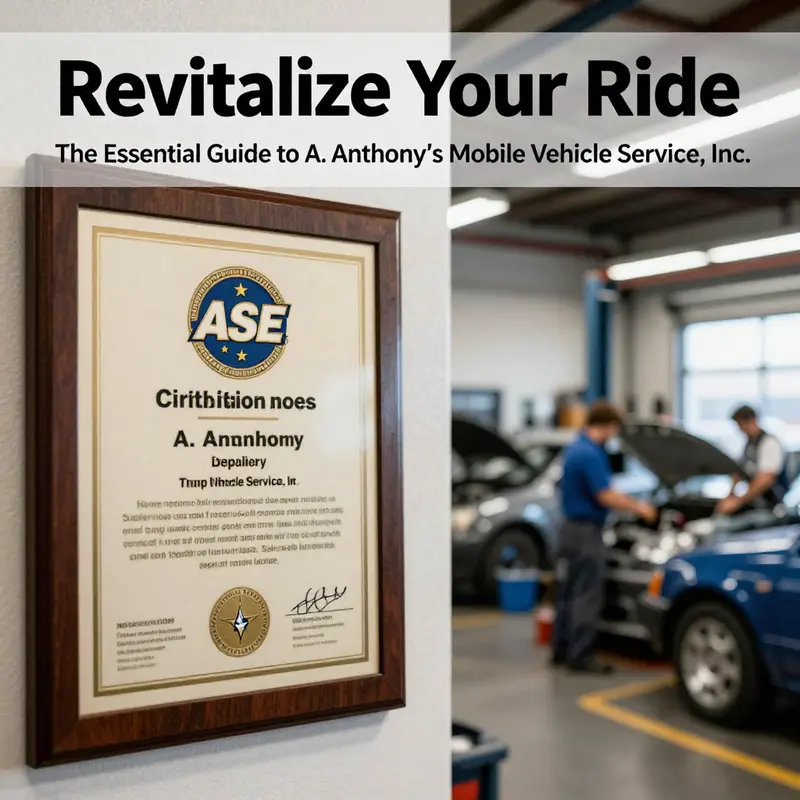
When a vehicle breaks down, the urge for quick help is strong, but reliability rests on something deeper than speed or the breadth of parts on a technician’s truck. In Anthony’s Mobile Vehicle Service, reliability is anchored by certification. The owner holds ASE certifications across multiple categories, signaling that expertise is the baseline for all work. In a mobile model that travels to the customer, credentials become a practical, measurable form of trust. It translates into confidence for homeowners worried about brake safety after a family trip or for fleet managers who need dependable maintenance to keep vehicles on the road.
What makes certification meaningful in a mobile context is not a simple checklist, but a standard expressed in how the team approaches each on-site visit. ASE certification represents sustained knowledge across automotive disciplines. Across engine performance, electrical systems, braking, heating and air conditioning, drive train, and more, the credentials signal that leadership has committed to a comprehensive understanding. This breadth matters when a technician arrives at a driveway or industrial complex with a vehicle showing a mix of symptoms. A certified technician is better prepared to connect clues and to identify issues that might otherwise be missed, enabling rapid, accurate diagnosis and reliable repair at a customer-chosen location.
The presence of eight-category certification, especially in the founder’s hands, sets a tone for the whole team. Leadership matters in service culture. When the leader demonstrates mastery across core technical domains, technicians are inspired to meet or exceed it, apprentices are mentored with professional rigor, and customers experience a consistent level of care on every visit. In mobile work, where the line between living space and workshop blurs, this consistency is especially critical. It reassures customers that the person on the other end of the line carries validated skills rather than improvised know-how.
Beyond confidence, certification acts as a guardrail for quality control. Certified technicians carry a framework of standards that guides the diagnostic approach, the sequence of checks, and the way work is documented and communicated. The journey from assessment to repair follows a nationally recognized standard rather than a purely local method. Certification provides a portable benchmark that travels with the technician, ensuring the customer receives the same level of scrutiny whether the job is a routine maintenance check or a complex component replacement.
In practice, certification informs safety, ethics, and communication. Standards emphasize not only repairs but also the ability to diagnose correctly, explain findings in plain language, and outline implications for long-term vehicle health. This matters at the kitchen table when a technician explains why a sensor is failing and what the steps are to prevent recurrence, and in maintenance planning when a certified professional helps balance immediate repairs with extending vehicle life through preventive care.
The mobile model benefits from standards paired with on-site flexibility. Certified technicians interpret data from modern diagnostic tools with a disciplined approach that respects the vehicle systems and the customer’s time. Certification is not abstract but a usable framework that enables mobile care to be precise and reliable, reducing callbacks and unexpected costs. The customer benefits from predictable maintenance costs and clearer expectations for what a given service will entail.
The chapter closes with a commitment to continuous improvement. Certification is a compass pointing toward evolving standards in a technology landscape that grows more complex every year. The founder’s multi-category certification suggests a forward-looking plan: invest in tools supporting mobile diagnostics, maintain a culture of training, and be transparent about what is known and what remains uncertain. These elements together provide a durable platform for delivering high-quality care wherever the customer needs it most.
For readers who want to continue exploring, the broader certification landscape offers more context on what ASE certifications cover and why they matter in today’s automotive world.
null
null
Final thoughts
A. Anthony’s Mobile Vehicle Service, Inc. exemplifies the future of vehicle maintenance, merging expertise, convenience, and community connection. Their mobile services not only save time for car owners and businesses but also build lasting relationships based on trust and excellent service. Choosing A. Anthony’s translates to choosing quality and reliability, ensuring that vehicles remain in peak condition regardless of where the customer is stationed.