
When a fairing tab cracks, it is tempting to blame the panel. Usually the panel is not the problem. Two things you control decide whether a tab survives: what the fairing is made of, and how hard the fasteners were tightened. Get those two right and the repair tends to last.
ABS and fiberglass handle that stress differently. ABS panels flex under vibration; fiberglass is stiffer and gives less before it cracks. The same bolt turned with the same effort can leave an ABS tab intact and split a fiberglass one.
Torque is the other half. Every fairing fastener has a published limit, and going past it crushes the plastic boss, stretches the mounting hole, and leaves a crack that only shows up days later. Stay within spec, allow for the material, and the tab survives heat cycles and road vibration.
Three areas cover most of what you need to know in practice:
- The differences between ABS and fiberglass as fairing materials, including how each handles flex and load
- Why fairing torque limits matter and what over-tightened fasteners actually do to a mounting tab
- Prevention steps you can apply during installation to avoid cracks before they start
For broader context, you can also review general DIY car repair fundamentals before starting the job.
What Fairing Mounting Tabs Are and How They Manage Load
Fairing mounting tabs are the small molded or laminated projections on the inside of a fairing panel. Each one is an attachment point where the flexible shell meets the rigid bracketry that ties the bodywork to the frame. Without them, a panel has nothing to hold it in line with the bike.
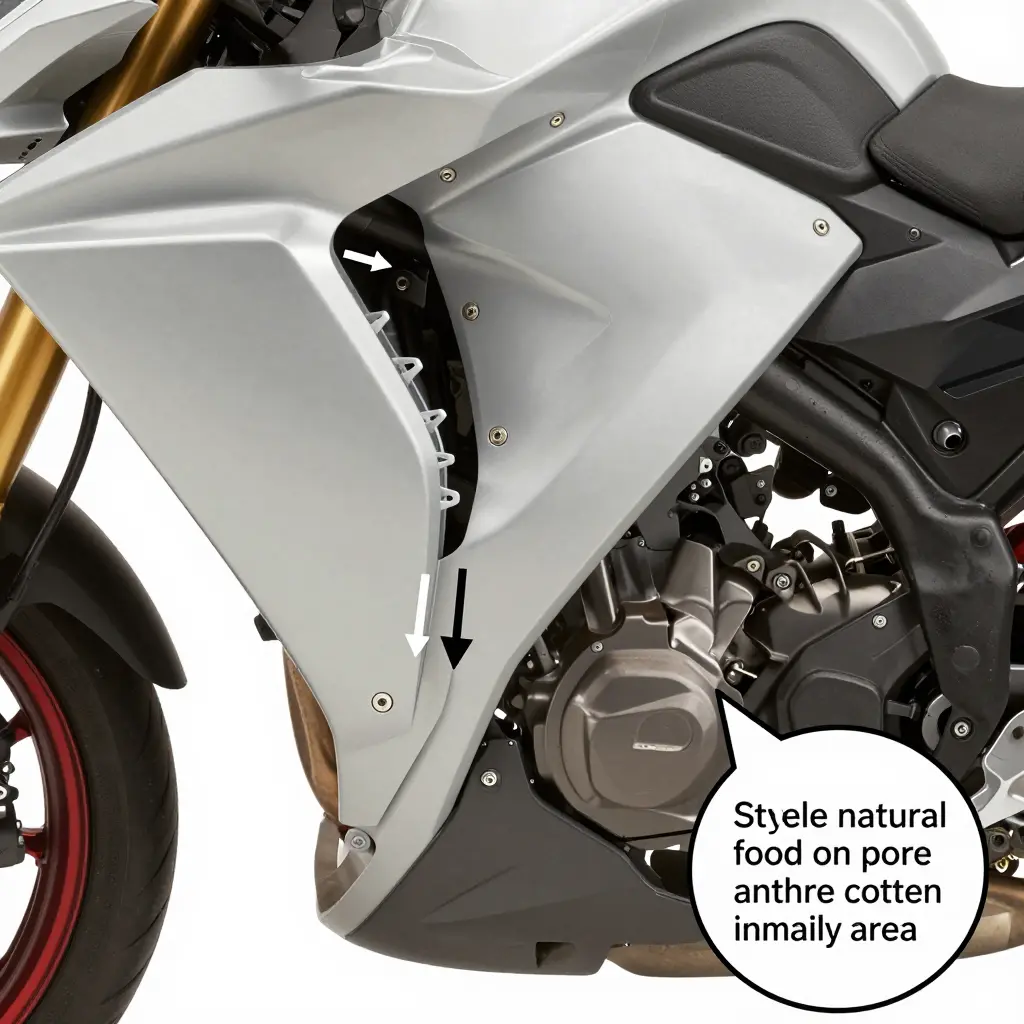
Tabs usually sit along panel edges, near seams, and by the nose, side panels, and lower cowl. Rubber grommets, well nuts, or shoulder bolts pair with them to hold the panel located while still letting it move a little.
Load runs from the fairing, through the brackets, into the frame. Wind pressure, vibration, and road impacts hit the large outer surface; the tabs gather that spread-out force into a few small contact points, and the brackets carry it onward to the frame. Good designs share the load across several tabs so no single one is overloaded.
Mounting Tab Stress Concentration
The term “mounting tab stress concentration” describes what happens when force crowds into a small area. A tab has limited cross-sectional area and often meets the panel at a sharp transition, so a load spread over the wide shell funnels into a tiny region. Bolt torque, thermal expansion, and vibration all meet at the base of the tab, which is why cracks start there.
The two common fairing materials react differently. ABS is a thermoformed thermoplastic: it flexes before it fractures and can be repaired with heat and plastic welding. Fiberglass is a laminated composite, stiffer and stronger in tension but more brittle, so it tends to crack instead of deforming. Repairing either one starts with careful surface preparation; rebuilding structural continuity around a cracked tab with seam sealer techniques, then matching the paint, keeps the repaired panel consistent with the rest of the motorcycle.
A tab looks like a simple piece of plastic, but it is under load the whole time you ride. Four physical forces account for most tab failures, and each has a clear cause and effect.
Stress Concentration at the Bolt Holes
Every bolt hole is a weak point. When a bolt clamps the tab, load travels through the material around the hole rather than spreading evenly across the whole tab, so force per unit area spikes at the hole rim — stress concentration. A sharp edge or a small scratch at that rim makes it worse. That is why a tab almost always fails at the hole, not in the middle of the panel.
Vibration Fatigue Under Constant Motion
A motorcycle vibrates constantly. Every engine pulse and road bump flexes the tab a little. The stress per cycle can be low, but millions of cycles steadily add up — a process called vibration fatigue. Cracks begin as micro-fractures at the hole edge, then grow until the tab separates. Stiff, brittle materials reach that point sooner than flexible ones.
Thermal Expansion Differences Between Materials and Metal Fasteners
Plastic and fiberglass fairings expand and contract with heat at different rates than steel or aluminum bolts. In engine heat or direct sun, the fairing grows while the metal fastener barely moves. Because the bolt holds the panel fixed, that mismatch turns into shear stress around the hole. Repeated hot-cold cycling works the material loose and widens the crack.
Over-Tightening Removes the Flex the Tab Needs
Tabs are meant to flex slightly and absorb vibration. Over-tightening removes that movement and pins the tab rigidly to the frame. A rigid tab cannot spread load, so stress collects at the bolt hole. This is why fairing torque limits matter: staying within spec preserves the controlled flex that keeps the tab alive. Exceed the limit and you trade a loose bolt for a cracked tab.
If you do your own wrenching, treat fasteners and torque specs as engineering data rather than guesswork. The same discipline carries across other DIY car repairs.
The choice between ABS and fiberglass comes down to how each material handles the stress concentrated at the mounting tabs. The table below compares the properties that decide whether a tab flexes, holds, or cracks under torque and vibration, so you can match your install method to the material in front of you.
| Property | ABS Fairing | Fiberglass Fairing | Failure Risk for Mounting Tabs |
|---|---|---|---|
| Flexibility | High – flexes and rebounds under load | Low – rigid and stiff, minimal give | ABS tabs bend to absorb stress; fiberglass tabs resist and then snap |
| Impact resistance | Good – tolerates vibration and minor knocks | Moderate – brittle under point loads | Fiberglass tabs crack easily at bolt holes from impact |
| Weight | Lighter (density around 1.0-1.1 g/cm3) | Heavier (density around 1.5-2.0 g/cm3) | Heavier fiberglass tabs add extra load to each mounting point |
| Repair-ability | Plastic-weldable or solvent-bonded | Easily repaired with resin and glass mat | Both can be fixed, but cracked fiberglass tabs are the most common failure |
| Thermal expansion | High (roughly 70-90 x10-6 per C) | Low (roughly 15-30 x10-6 per C) | ABS expands more, stressing tabs across temperature swings |
| Typical tab cracking tendency | Moderate to low; cracks at over-torqued bolts | High; notorious for hairline cracks at tabs | Fiberglass carries the greatest tab-cracking risk |
| Average cost | Lower for mass-produced OEM panels | Higher for custom and aftermarket parts | Budget ABS is cheaper to replace once a tab breaks |
The pattern holds: ABS fairing tabs bend and forgive, while fiberglass fairing tabs hold firm and then crack. Match your torque and mounting method to the material’s natural behavior and you are far less likely to snap a tab. Our DIY car repairs guide walks through safe bolt-up techniques for both.
Torque Limits for Motorcycle Fairing Fasteners
Torque is the rotational force applied to a fastener, measured in newton-meters (Nm) or foot-pounds (ft-lb). Tightening a bolt stretches it slightly, and that stretch creates the clamping force that holds a fairing panel against its mounting tab.
Manufacturers publish torque values because every fastener is engineered for a narrow window of clamping force. These fairing torque limits reflect bolt diameter, thread pitch, fastener material, and the strength of the plastic or composite tab being secured. Staying inside the window protects the hardware and the bodywork.
Over-torquing does the most damage. Exceeding the specified fairing torque limits compresses the mounting tab beyond its elastic range. On ABS panels the plastic deforms, whitens, and eventually cracks; on fiberglass the resin can shatter around the bolt hole. Either way you get a stress fracture that spreads with every vibration cycle.
Under-torquing is just as harmful in the opposite direction. A loose fastener cannot maintain clamping force, so the panel shifts and the bolt backs out under engine and road vibration. This flexing lets the tab rub, wears through paint, and can send a panel detaching at speed.
A calibrated torque wrench is the only reliable way to reach the target value. Beam and click-type wrenches deliver repeatable results, while “good and tight” by hand almost always overshoots on small fasteners.
Thread-locker adds a second layer of security. A medium-strength blue compound fills the thread gaps, resists vibration loosening, and still allows later removal. Apply a drop to clean threads after the fastener is torqued to spec.
Always confirm each fastener’s specification in the service manual before reinstalling fairings.
Recommended Torque Limits by Fastener Size
Getting the wrench tension right is the single best defense against cracked mounting tabs. The chart below pairs common fairing fastener sizes (M4 through M8) with the torque values that ABS plastic and fiberglass can realistically survive without stress cracking.
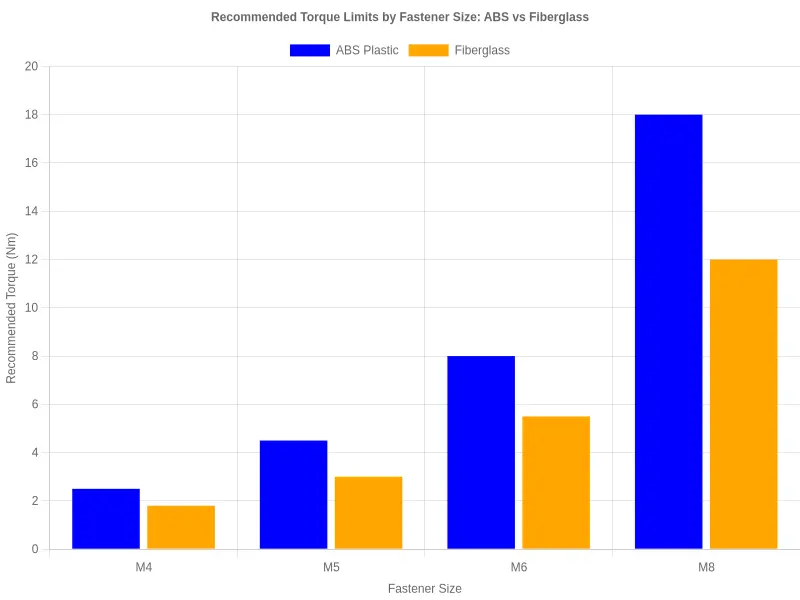
This chart shows the safe torque ceiling for each common fairing bolt material. Because fiberglass tolerates noticeably less torque than ABS at every size, it helps you pick the right setting on the wrench before a tab distorts or snaps. Use it as a quick reference so you tighten to the material, not to a guess.
Quick reference table
| Fastener Size | ABS Plastic (Nm) | Fiberglass (Nm) |
|---|---|---|
| M4 | 2.5 | 1.8 |
| M5 | 4.5 | 3.0 |
| M6 | 8.0 | 5.5 |
| M8 | 18.0 | 12.0 |
How to read it
- Start low, then creep up. The values above are upper limits, not targets. Snug the fastener by hand first, then bring it to spec with a calibrated torque wrench.
- Respect the material gap. Note that the fiberglass figures run roughly 28-33% below their ABS counterparts. A setting that feels “just right” on an ABS tab can crack a fiberglass one instantly.
- Beware used hardware. Worn threads, oil contamination, and reused lock washers all rob clamping force, tempting you to overtighten and overshoot the limits shown here.
Pairing these specs with a solid set of DIY car repair fundamentals makes the whole process far less intimidating.
Common Causes of Fairing Mounting Tab Cracking
A hairline crack radiating from a mounting point a few days after a fairing goes back on is almost always mechanical stress rather than bad luck. Mechanics see the same few causes after an install, and knowing why fairing mounting tabs crack is the first step toward avoiding a repeat. Most of these trace back to simple assembly mistakes.
- Over-torqued bolts crush and stress the plastic around the mounting hole until it splits.
- Mismatched material and fastener expansion causes the plastic and metal to grow and shrink at different rates, loading the tab.
- Missing rubber grommets or washers remove the flex and cushioning that absorb road shock.
- Vibration without thread-locker lets fasteners back out and wallow in the hole, eventually cracking the tab.
- Cross-threaded fasteners create uneven pressure that pinches and fractures the surrounding plastic.
- Using the wrong bolt length drives the shank too deep or leaves too little engagement, distorting the mount.
The fix is rarely about brute force; it is about matching hardware to the fairing material, respecting torque specs, and keeping the correct isolating hardware in place. A good DIY car repair guide can help you build sound habits before your next panel goes back on.
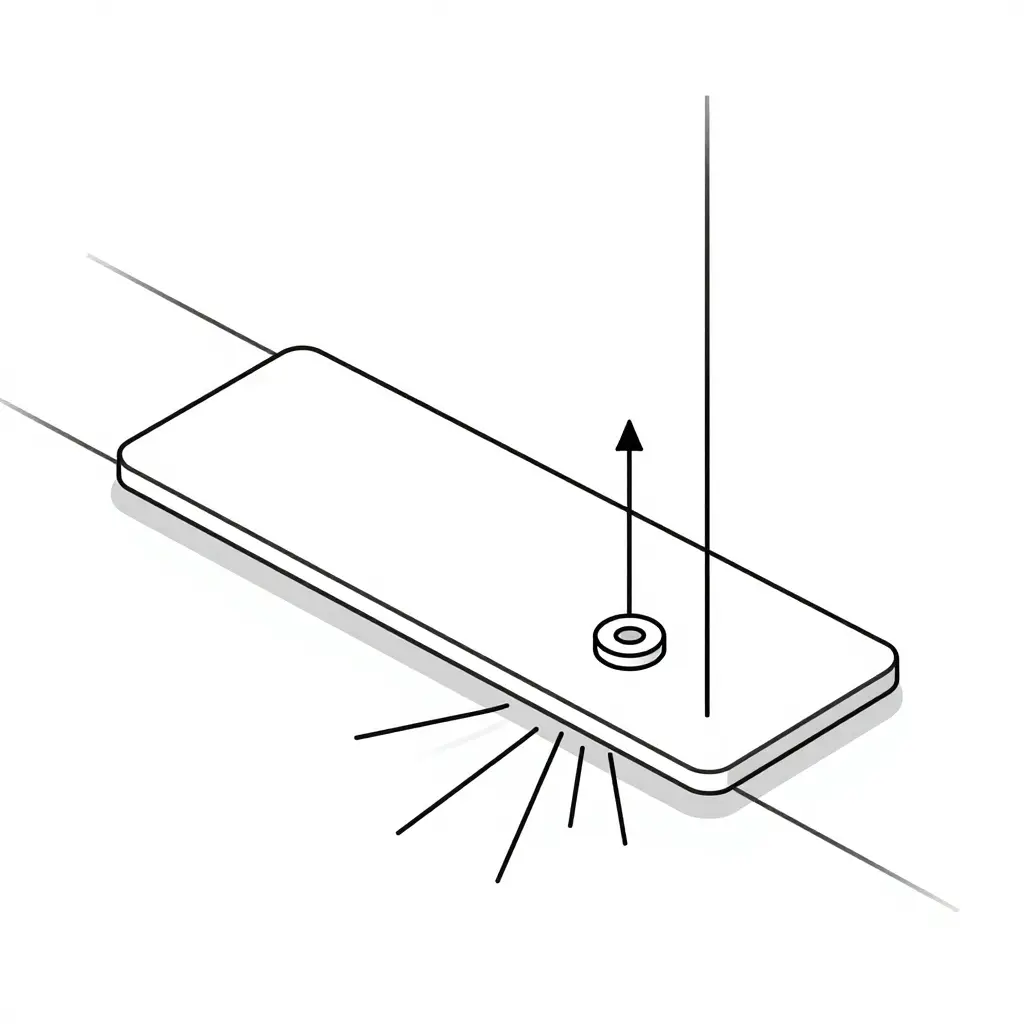
A simple line drawing makes the invisible obvious: the arrows show the pulling and bending forces, while the highlighted corner marks the spot where stress stacks up and cracks begin.
Prevention and Best Practices
Preventing fairing tab cracks comes down to controlling the two things that break them: unsuitable materials and uneven stress at the mounting points. The same principles apply whether you work in a shop or a driveway.
Choose the right material for the application. Match the fairing and tab material to how the bike is used. OEM ABS tabs flex slightly and absorb vibration, while fiberglass tabs are stiffer and more brittle but easier to repair in layers. If a panel sees constant vibration, favor a material that tolerates flex rather than one that resists it. For a broader walkthrough of matching parts to real-world use, our comprehensive DIY car repairs guide is a solid reference.
Use rubber grommets and washers. Isolate the fastener from the plastic. A rubber grommet plus a nylon or rubber-backed washer lets the panel move slightly without loading the tab, which is the single most effective way to stop hairline cracks from spreading.
Follow correct torque limits. Over-tightening is the leading cause of fresh-install cracks. Use a calibrated torque wrench and the manufacturer’s spec, typically just a few inch-pounds for plastic fasteners. Tighten in a star pattern so the load stays even.
Apply thread-locker, not more torque. A drop of medium-strength thread-locker holds bolts without forcing you to over-torque. It also prevents vibration from slowly loosening hardware that would otherwise need re-snugging.
Add reinforcement plates. On high-stress or repaired tabs, bond a thin aluminum or fiberglass backing plate behind the tab and redrill the hole. This spreads the load across a wider area and dramatically extends service life.
Used together, these steps turn what we know about fairing-tab failure into a repeatable installation routine that keeps panels secure.
Frequently Asked Questions About Fairing Tabs and Torque
Do ABS or fiberglass fairing tabs crack more easily?
Both materials can fail, but they crack differently. Fiberglass tabs are stiff, so they resist flex yet tend to split or shatter under sudden impact. ABS plastic is more flexible and handles vibration better, though it fatigues over time at stress points. In real-world use, fairing mounting tabs crack often on both materials, so the material alone rarely prevents the issue.
What is the correct torque for fairing bolts?
Fairing fasteners are small and usually thread into plastic or thin metal, so they demand gentle torque. Most manufacturer specs land between 0.5 and 1.5 Nm (roughly 4 to 13 in-lb) for trim bolts. Always verify against your service manual, because fairing torque limits vary by model. When unsure, tighten snug by hand and stop before the tab flexes.
Can cracked fairing tabs be repaired?
Yes, many cracked tabs can be repaired successfully using proven DIY car repair techniques. For ABS, plastic welding or a solvent-based adhesive plus a reinforcing patch works well. Fiberglass repairs use resin and mat laid behind the tab. Clean the surface, remove paint, and support the joint while it cures. A careful repair often outlasts the original tab.
What causes fairing tabs to crack right after installation?
Immediate cracking usually points to over-torqued fasteners, misaligned panels, or missing rubber grommets. Forcing a bolt through a misaligned hole stresses the tab instantly, and vibration from a loose bracket speeds up failure. Recheck alignment, fit fresh washers and grommets, and confirm torque values before calling the job finished.
How do I choose replacement fairings?
Begin by matching the material, fitment year, and finish of your original panels. Aftermarket ABS is affordable and flexible, while fiberglass suits custom or race builds. Confirm the kit includes reinforced mounting tabs, correct hardware, and pre-drilled holes. Reading reviews and checking return policies helps you avoid poorly fitting sets that crack prematurely.
The Takeaway: Match the Material, Respect the Torque, Use the Right Hardware
Fairing mounting tabs crack for three predictable reasons, and understanding each one turns a frustrating repair into a manageable job. When tabs keep failing, it is worth tracking down the recurring issue instead of replacing parts blindly.
Material choice sets how much abuse a tab can take. ABS fairings flex slightly under load, which absorbs vibration and small impacts before a tab gives way. Fiberglass fairings are stiffer and stronger in a straight pull, but they resist flex, so more force goes straight into the mounting point.
Torque matters more than most riders expect. Over-tightening a bolt is the single most common cause of hairline cracks around a tab, so follow the manufacturer’s specification and use a calibrated torque wrench rather than guessing by feel.
Installation hardware does quieter work than it gets credit for. Rubber grommets, wellnuts, and correctly sized shoulder bolts isolate vibration and let the fairing shift as the bike flexes. Skip them or swap in rigid hardware and you invite stress cracks over time.
On balance, ABS stays the more forgiving choice for daily riders because it tolerates flex and impacts well, while fiberglass appeals to those chasing tighter body lines and lighter weight.
For riders sourcing replacements, Summit Fairings (summitfairings.com) says it carries over 3,000 styles at 10-40% lower prices than other sites, backed by a six-hour answer guarantee.
Treat material, torque, and hardware as one system, and your tabs will hold up far longer.