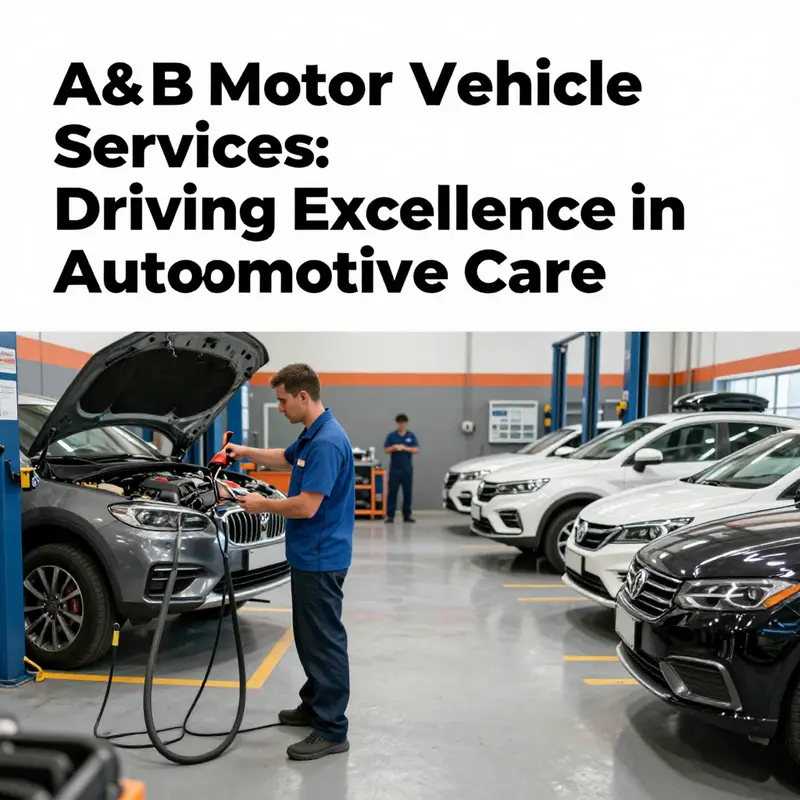
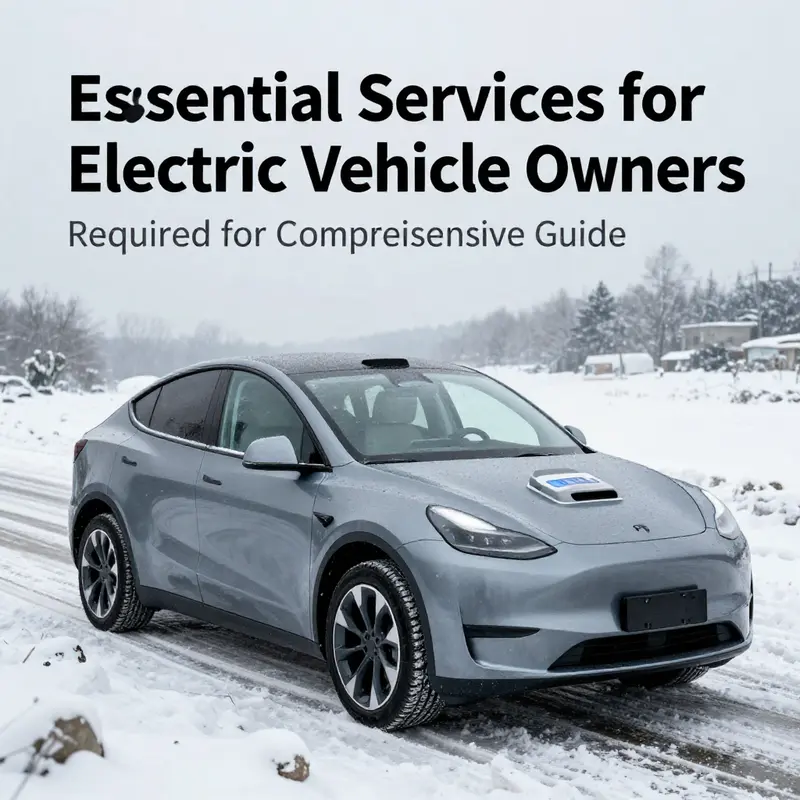
Owning an electric vehicle (EV) involves more than just enjoying the benefits of eco-friendly transport. As the automotive landscape shifts, electric vehicles demand a distinct set of services tailored to their unique characteristics. From safeguarding essential components like the battery and powertrain to establishing efficient charging infrastructures, the services required are diverse and critical. This guide will explore five essential service categories: Core Battery & Powertrain Protection, Charging Infrastructure & Support, Specialized Roadside Assistance, Software & Digital Experience Management, and Seasonal & Environmental Adaptation. Each chapter will delve into these topics, helping local private car owners, used car buyers and sellers, and small business fleet operators understand how to navigate their electric vehicle journey with confidence.
null
null
Beyond the Plug: Building a Human, Digital, and Geographical Network to Power Electric Vehicle Ownership
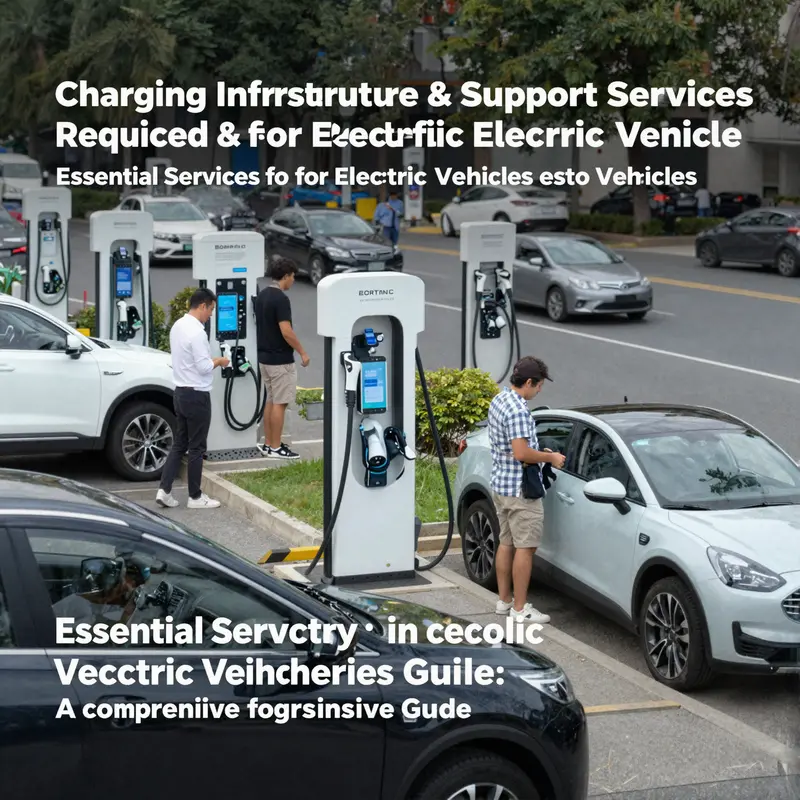
The path to widespread electric vehicle adoption does not end at the moment a driver purchases a car with a charge port. It begins there and extends through a carefully woven system of charging infrastructure and a suite of support services designed to make every mile efficient, safe, and predictable. When seen as a cohesive ecosystem, charging networks and the services around them reveal why a service framework is as essential as the vehicle itself. The question not only asks what kind of charger exists or how fast it can fill a battery, but how the network operates, how reliable it is, and how easy it is for a driver to access energy without friction. This chapter treats charging infrastructure and the associated support services as the backbone of a practical, user friendly, and future ready electric world. It is an integration of hardware availability, digital orchestration, and the human services that keep the system resilient under pressure and adaptable to changing conditions on the ground and in policy corridors.
Interoperability and standardization sit at the heart of the practical reality of charging. For drivers, switching between networks should feel as seamless as using a single bank interface across many stores. Yet the landscape is often fragmented, with different connectors, varying communication languages between chargers and vehicles, and diverse billing systems. This is not a mere technical quibble; it translates into anxiety for drivers who worry about whether a given station will actually work when they arrive, whether they will be able to pay for the service, and whether the charging session will complete without a hitch. The chapters of this ecosystem are being rewritten by public and private actors who recognize that universal compatibility reduces friction and expands the usable charging footprint. In large markets, an ongoing push toward unified standards is the vehicle for achieving reliable access to charging near homes, at workplaces, and along long journeys. A more coherent framework invites more predictable charging experiences and lowers the cognitive load on the consumer who must plan routes with energy budgets in mind. The result is not just convenience but confidence, which is arguably the most powerful driver of adoption.
The digital spine of charging infrastructure is where real time information, usability, and efficiency come together. Real time availability and status information conveyed through apps and navigation systems are not a luxury; they are a necessity. An energy network that can show a charger as occupied, out of service, or temporarily slow due to maintenance gives the driver a reliable map of what to expect. The payment and authentication layer must be straightforward and secure, supporting a seamless transition from door to charge without the friction of wallet juggling or multiple accounts. The most compelling systems also create meaningful incentives and discounts that encourage drivers to use or prefer certain networks in particular circumstances, such as off peak hours or off peak locations. In practical terms, drivers should be able to locate a charger, verify its power level, initiate and complete a payment, and receive a receipt all within a single, well designed interface. When this is achieved, charging ceases to be an obstacle and becomes just another routine in the journey of ownership.
Reliability is the hidden currency of the charging economy. It is easy to overemphasize speed and capacity, but without consistent uptime and predictable performance, even the fastest charger loses value. Maintenance and monitoring of charging stations must be proactive, with regular checks on connection integrity, cable safety, and cooling systems that prevent thermal throttling. Operators must implement remote diagnostics and rapid fault response so that downtime is minimized. The end user benefits when a station is supported by a robust maintenance regime that catches issues before they affect customers. That reliability also depends on a broad and well funded network, covering public spaces and private locations alike, because the most convenient charging often happens in the places a driver already visits daily. The infrastructure thus grows not merely in the quantity of chargers but in the depth of service and confidence that each charging event will be simple and successful.
Payment ecosystems, in particular, illuminate how the network must harmonize the interests of the user, the station operator, and the policy environment. A unified, frictionless payment system reduces the time spent on charging, which translates into more energy delivered to vehicles and less time spent fumbling with apps or cards. The ideal system can recognize the user and the vehicle, apply appropriate pricing or incentives, and record usage that feeds data back to utility grids and city planners. When payments are reliable and transparent, drivers are more willing to plan longer trips and to invest in charging infrastructure at home or at work, because the economic calculus becomes clearer and more favorable. This is where the policy and the private investment communities converge. Governments can accelerate adoption by incentivizing the buildout of charging networks in underserved areas, streamlining permitting for new stations, and supporting standardized equipment. Private operators, for their part, must deliver reliable service, optimize maintenance, and participate in interoperable platforms that amplify the reach and usefulness of their investments. The result is a charging ecosystem that feels like a single, continuous energy grid rather than a patchwork of isolated points.
A practical look at future demand underscores the scale of transformation expected in the coming years. Projections for large economies suggest that tens of millions of chargers could be required by the next decade to meet demand, with investment running into the tens of billions of dollars. Similar dynamics are at play in other regions where urbanization, policy ambition, and consumer interest converge to accelerate deployment. These numbers are not abstract. They map onto the daily experiences of people who depend on charging for commuting, family travel, and business operations. The implication is clear: without a coordinated approach to infrastructure planning and deployment, the growth of EVs will be constrained not by the vehicle but by the energy network that supports it. Nations around the world are actively working to design charging models that fit their landscapes, balancing the needs of rural and urban areas, grid capacity, and affordability. The shared emphasis across regions is a commitment to a network that people can rely on, in every city and on every highway, long into the future.
Infrastructure is not merely about cables and hardware. It is a system of services designed to make energy accessible, predictable, and economical. The value of this system lies less in any single element and more in how well the elements fit together. The real strength of a robust charging ecosystem is its ability to reduce anxiety for drivers, accelerate the pace at which homes can be powered by electricity, and enable longer journeys with confidence. The human dimension is critical here. A driver should feel that the energy system serves them, not the other way around. That means easy access at moments when energy is needed, assistance when something goes wrong, and clarity about costs and progress. It means operators committing to safety, including robust high voltage safety protocols and reliable roadside support that can navigate a high voltage environment with trained personnel. It means digital platforms that empower users with information, control, and options that make everyday charging a routine part of life rather than a special event. And it means public and private collaboration that aligns incentives, builds capacity, and shares best practices across borders.
As a practical resource and path forward, the ecosystem approach invites readers to view charging not as isolated charging points but as an integrated service network. A comprehensive strategy includes real time data, interoperable payment, reliable maintenance, and policies that encourage investment while protecting user interests. It also invites ongoing innovation in energy management at the grid level, for instance through dynamic pricing, demand response, and smarter charging that aligns with renewable generation. The net effect is a more resilient energy system that supports sustainable mobility and makes the transition to electric transport smoother for every household, business, and community. To explore related perspectives and supplementary insights, you can consult industry literature and practitioner resources, including KMZ Vehicle Center blog and ScienceDirect resources that discuss charging infrastructure standards and deployment challenges that shape the direction of the field.
EV Roadside Rescue: Essential High-Voltage and Battery Safety for Roadside Recovery

EV roadside rescue is a critical service that combines safety, diagnostics, and practical energy delivery to keep drivers mobile. High-voltage systems require trained technicians, proper PPE, and purpose-built tools. On arrival, the technician confirms the vehicle is powered down, isolates the high-voltage battery, and verifies that no re-energization can occur during work. Portable diagnostic kits read fault codes, check cell balance, and assess thermal behavior, helping determine whether a temporary fix is possible or if a tow is necessary. When safe to operate in place, the team may perform minor repairs, reset software warnings, or guide the driver to a nearby charger; if not, a controlled tow to a battery-focused service center preserves battery health and safety.
Mobile charging can bridge the gap by delivering energy through compatible connectors, enabling enough range to reach a public fast charger or residence. Towing for EVs uses electric-friendly equipment and careful handling to minimize stresses on the battery pack and suspension. Beyond the hardware, digital tools offer remote diagnostics, navigation to charging options, and virtual technician support to shorten downtime. The result is a service ecosystem that keeps EV ownership practical and confident, even when the road tests the battery, the charger grid is momentarily unavailable, or a safety issue must be addressed before driving again.
Guardians of the Connected Drive: Software, Safety, and the Digital Experience That Define Modern Electric Vehicles
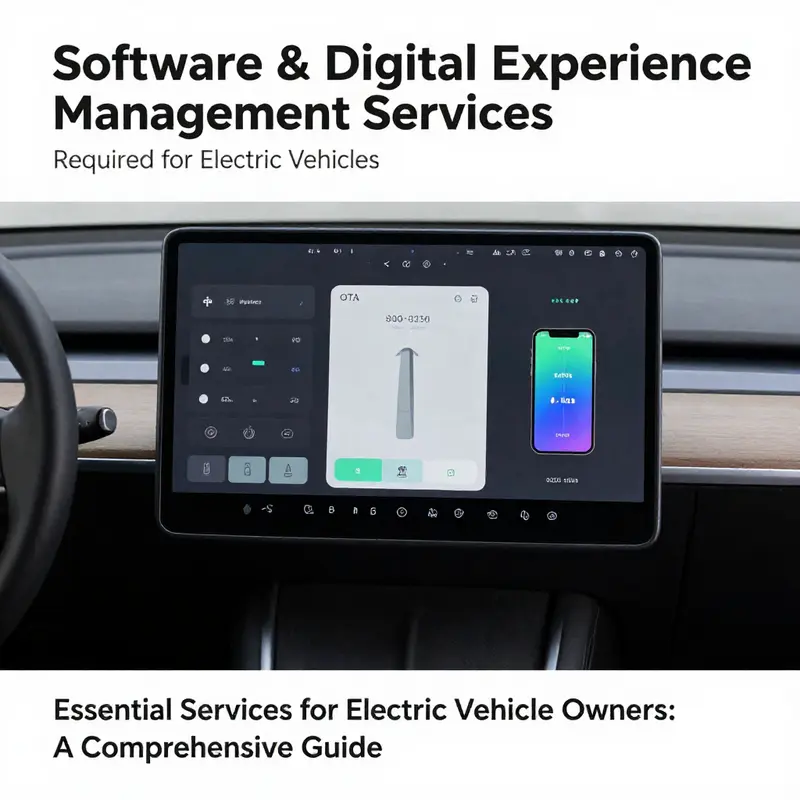
The shift to electric propulsion has moved the conversation from simply swapping an internal combustion engine for a battery pack to reimagining what a car can be. In this new era, software and digital experience management are not afterthoughts; they are the backbone of safe, reliable, and satisfying EV ownership. Vehicles become software-defined, and their value grows with the quality of the on-board intelligence, the security of their data, and the elegance of their user experience. At the heart of this transformation are the systems that govern the battery, the powertrain, and the electronic controls—the three electric core. But beyond hardware, the true value lives in software that can be updated, tuned, and continually improved long after a car leaves the factory. This is the new service ecosystem that owners rely on daily, from the moment they plug in a charger to the moment they plan a long highway journey. The chapters that follow will explore how this software-centric approach translates into concrete services, how it protects the battery as the most expensive asset, and how it elevates the entire ownership experience through safety, connectivity, and intelligent design.
In modern EVs, the software stack touches every aspect of the vehicle’s performance and safety. Regular, over-the-air updates are not optional features; they are essential mechanisms for optimizing charging strategies, refining energy recovery during braking, and unlocking improvements that make the car feel newer over time. The integration of OTA capabilities also enables adaptive features that respond to driver habits, climate, and road conditions. At the same time, the vehicle must remain predictable and secure. Functional safety and cybersecurity are no longer siloed concerns but ongoing disciplines embedded in every development phase, from initial concept through to production and beyond. Standards such as ISO 21434 for cybersecurity and ISO 21449 for functional safety guide these efforts, ensuring that the software behaves reliably in the real world and that protections exist against increasingly sophisticated threats.
The practical implication of this software-centric reality is a demand for rigorous testing and certification that spans the entire lifecycle. EVs are not simply tested for mechanical reliability; they are evaluated for software integrity, data privacy, and resilience against cyberattacks. The testing and certification process must validate that infotainment systems, OTA update mechanisms, and AI-enabled features operate safely under diverse scenarios. This is a shift from traditional vehicle testing to a holistic, software-informed approach that requires collaboration across disciplines. A trusted testing and certification partner helps engineers bridge gaps between concept, design, and mass production. They provide frameworks to validate that the software architecture supports modularity, that updates do not undermine safety, and that new features meet regulatory and consumer expectations. In practice, this means a more transparent development timeline, clearer risk management, and a roadmap for continuous improvement that owners can trust.
Alongside safety and reliability, the digital experience is a defining element of contemporary EV ownership. Modern software-defined features go beyond convenience. Remote vehicle control, such as pre-heating or pre-cooling the cabin, can improve comfort and efficiency by preparing the battery for the journey and protecting range in extreme weather. The right software management approach makes these capabilities feel natural, almost invisible, yet profoundly impactful on daily life. As vehicles gather more data—from battery health indicators to charging patterns and user preferences—the opportunity to tailor experiences grows. This creates a virtuous cycle: smarter interfaces and more efficient performance encourage drivers to use EVs more often, which in turn provides richer data to refine algorithms and enhance safety. The result is a vehicle that learns, adapts, and remains aligned with the driver’s needs while complying with evolving regulatory requirements.
A crucial, often overlooked dimension is governance—how software, data, and safety practices are organized within the company responsible for the car. The SDV (software-defined vehicle) paradigm requires a structured approach to modular architecture, with clearly defined interfaces and upgrade paths. It also demands robust data management practices so that information collected from vehicles in the field can be used responsibly to improve products while protecting customer privacy. This governance layer extends beyond engineering teams to procurement and quality groups, which must verify that components and materials used in software-defined systems meet international standards and supply chain requirements. It also extends to security teams, who perform risk assessments to identify and mitigate new cyber threats that arise as vehicles become more connected. The objective is not just to deploy features but to ensure that every feature, every data exchange, and every remote update is traceable, auditable, and compliant with global norms.
The literature on this topic consistently points to a comprehensive, end-to-end model for software and digital experience management. At the core is a commitment to functional safety and cybersecurity as ongoing obligations rather than one-time milestones. This means an integrated development process that weaves safety and security into every decision, from the initial concept to the final production software and beyond. It also means leveraging external validation and certification to create independent assurance that the product remains trustworthy after launch. A leading standards and testing approach emphasizes validating that OTA updates are safe, that infotainment and vehicle-control software interact without introducing faults, and that AI-driven features learn from real-world usage without compromising safety or privacy. While this requires investment, it translates into lower risk, longer vehicle lifecycles, and higher consumer confidence, which ultimately lowers total cost of ownership and strengthens brand loyalty.
The digital experience also intersects with sustainability and governance. As automakers pursue responsible design, they increasingly rely on data management tools to verify content and compliance for recycled materials used in batteries and infrastructure. This enables transparent reporting on ESG goals and helps navigate regulations such as REACH and RoHS, as well as state-level or regional protections like California’s Proposition 65. Verifying material content, ensuring traceability, and establishing responsible sourcing become essential components of a modern EV program. The result is a more resilient supply chain and a credible sustainability narrative that resonates with consumers, regulators, and investors alike. In short, software-defined vehicles demand a holistic, auditable, and forward-looking approach that links the car’s digital experience with broader environmental and governance objectives.
To make sense of this, consider how the different players contribute to the end user’s peace of mind. Engineers design modular software architectures that support safe upgrades and rapid iteration. Safety and cybersecurity specialists conduct risk assessments to anticipate threats and ensure robust defenses. Compliance teams map features to global standards, so regulators can recognize and approve new capabilities quickly. Meanwhile, digital experience teams curate the user interface and interaction models so that drivers receive a coherent, personalized experience without being overwhelmed by data or controls. The net effect is a vehicle that is not only more capable but also more trustworthy—able to evolve with the owner’s needs while preserving safety, privacy, and regulatory compliance.
As the industry advances, the value of external expertise becomes clearer. A comprehensive approach to software and digital experience management recognizes that the most effective solutions arise from integrating testing, certification, and consulting across the development lifecycle. This collaboration helps manufacturers embed functional safety and cybersecurity into every stage of development and operation, ensuring that OTA updates, infotainment platforms, and AI-driven features operate securely and reliably. It also supports the broader shift toward sustainable innovation, where chemical testing and data management tools verify recycled materials in batteries and infrastructure and demonstrate compliance with environmental and consumer-protection regulations. The outcome is not merely a technically sound vehicle, but a product that earns consumer trust through demonstrated safety, privacy, and responsible stewardship of resources.
For those seeking deeper industry context, the evolution of software-defined vehicles is well illustrated by standards-driven practices and the growing demand for rigorous validation across domains. OTA strategy, remote-control capabilities, and adaptive interfaces exemplify how software can enhance both safety and user satisfaction when governed by robust processes. If you want continuous updates on industry insights and practical implications for EV ownership, you can follow the KMZ Vehicle Center blog, which aggregates perspectives on vehicle maintenance, mobility trends, and the evolving service ecosystem. KMZ Vehicle Center blog.
Further reading on standards, testing, and the broader software-defined vehicle landscape can be found in external resources that detail how the automotive sector is aligning safety, cybersecurity, and regulatory compliance with rapid software-enabled innovation. For researchers and practitioners seeking a consolidated view of how these practices unfold in real-world contexts, an external resource offers a structured overview of functional safety, cybersecurity, and the governance of SDVs in modern mobility. External link: https://www.ul.com/solutions/automotive/software-defined-vehicles
In sum, the software and digital experience management layer of electric vehicles is not a single feature or a peripheral service. It is a disciplined ecosystem that underpins safety, reliability, privacy, and convenience. By embracing OTA updates, rigorous testing and certification, and ESG-conscious data management, automakers create EVs that improve over time, protect owners from emerging risks, and demonstrate a commitment to responsible innovation. The result is a smarter, safer, and more engaging driving experience that aligns with the broader trajectory of sustainable mobility and digital transformation.
null
null
Final thoughts
Understanding the essential services required for electric vehicles is paramount for any owner, whether they are private car buyers, sellers, or fleet operators. By focusing on core battery and powertrain protection, establishing reliable charging infrastructures, securing specialized roadside assistance, managing software experiences, and preparing for seasonal variations, owners can significantly enhance their EV ownership journey. These services not only elevate the safety and convenience of electric vehicle usage but also contribute to the overall satisfaction and sustainability goals of EV users. As electric vehicles continue to evolve, staying informed about these services will empower owners to make educated decisions that foster long-term benefits.