
The Servicing Dilemma: Oil Life Monitor vs Mileage Interval
How often should a car be serviced? Most owners get their answer from one of two places: the oil life monitor on the dashboard, or a fixed mileage number in the owner’s manual. The two rarely agree, and that gap is where the dilemma starts.
Modern engines estimate oil condition with sensors and software. A typical monitor counts engine revolutions and watches coolant temperature, trip length, and idle time, then turns that into a remaining oil life percentage. Many owner’s manuals and service shops still go by a hard number instead – every 5,000 or 7,500 miles, no matter how the car is driven. Both methods have something going for them, and neither is right in every case. For related guidance, see these time versus mileage considerations.
The better choice depends on how you drive, the oil you use, and what the manufacturer specifies. Three questions matter most:
- What does each system measure, and what inputs does it rely on?
- How do the two recommendations differ in practice?
- Which one should you trust for your vehicle?
What Is an Oil Life Monitor?
An oil life monitor is software that estimates how much useful life is left in your engine oil and shows it as a percentage. Instead of waiting for the odometer to hit a number, it keeps evaluating the conditions that actually break oil down.
It combines several inputs: coolant temperature, total engine revolutions, trip length, and engine load. Short trips that never let the oil warm up count against it more heavily, because they leave moisture and fuel in the crankcase. Steady highway running at normal temperature is treated as gentler. Some vehicles add an oil condition sensor that reads dielectric properties or contamination directly, which tightens the estimate further.
Because it reacts to real driving, a monitor adapts to how the vehicle is actually used. Two drivers covering the same distance can watch very different countdowns. That is the point: a fixed interval cannot tell a gentle commute from months of stop-and-go towing.
Your driving habits are the single biggest variable in how fast oil breaks down, which is why matching your oil change interval to your actual use matters more than following a mileage sticker.
When the countdown gets low, most systems need a specific reset. That usually means working through a menu or holding a button combination with the ignition in a set position. Skip it and the counter stays out of sync, so confirm the reset took.
What Is a Mileage-Based Service Interval?
Before onboard computers tracked oil life, the simplest way to schedule maintenance was to pick a number and stick to it. A mileage interval is just that: a fixed distance the odometer must reach before the next oil change, tire rotation, or inspection. When the number comes up, you book the vehicle service – no sensors, no guesswork.
Manufacturers, quick-lube shops, and older maintenance schedules still use a hard figure. Service books commonly call for fresh oil at 5,000, 7,500, or 10,000 miles, and the reminder sticker on the windshield repeats the same message.
Those round numbers rarely describe your actual driving. They tend to come from worst-case assumptions – city congestion, dusty roads, heavy loads – so the schedule protects the manufacturer against the hardest-used vehicle rather than rewarding an easy one.
The trade-off is real. One number ignores short trips that never warm the engine, towing that strains the drivetrain, and extreme temperatures that break fluids down faster. A commuter in mild weather and a driver hauling a trailer through desert heat are told to come back on the same day.
So why do owners and shops still like it? Predictability. A mileage interval is easy to remember, easy to budget for, and easy to show a buyer at resale.
Timing matters too. Cars that sit for weeks benefit from time-based reminders, while high-mileage drivers do better tracking distance – this guide on comparing time-based versus mileage-based oil changes breaks the decision down.
Factors That Change How Often You Should Service
Many drivers treat the oil change interval as a fixed number, but real-world conditions keep moving the point at which service is actually due. These are the factors that matter most.
- Trip length. Short trips that never let the engine reach full operating temperature leave moisture and fuel in the oil, so it degrades faster than the odometer suggests.
- Ambient temperature and cold starts. Frequent freezing-weather starts thicken the oil and increase metal wear, which pushes you toward shorter intervals than the manual lists.
- Towing and hauling. Trailers, boats, and heavy loads raise engine and transmission temperatures, speeding up oil breakdown and calling for more frequent attention.
- Stop-and-go traffic. Constant idling and repeated hard acceleration count as severe service and wear oil down faster than steady highway cruising.
- Fuel quality and engine type. Certain designs, such as turbocharged and direct-injection engines, put more soot and contaminants into the crankcase.
- Oil type (conventional vs synthetic). Full synthetics resist heat and oxidation far longer, often supporting a longer interval than conventional oil, with blends in between.
- Time elapsed since the last change. Oil degrades with time even when you barely drive it, so most manufacturers publish a time limit alongside the mileage one.
- Engine blow-by and contamination. Worn piston rings push combustion gases into the crankcase, and a clogged PCV valve makes that blow-by worse.
- Severe-duty driving. Dusty roads, heavy loads, and hard driving stress the turbo, so watching for turbocharger warning signs helps you time service before damage sets in.
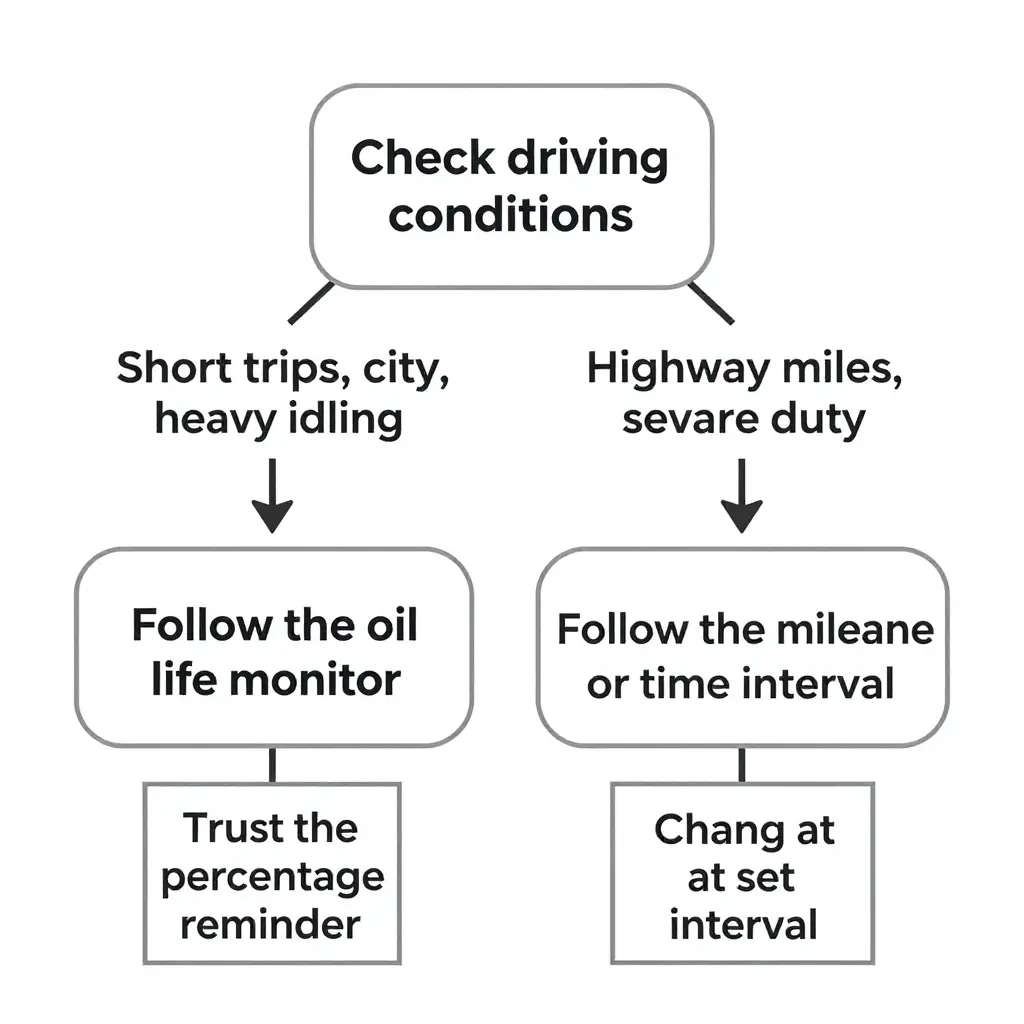
How to read this diagram: It starts with one question about your driving conditions, then splits into the two paths every owner faces. If most of your miles are short city trips with heavy idling, the monitor usually reflects that stress. If you run steady highway miles or severe duty, a set interval is often safer.
Match your driving to the right reminder rather than guessing. For a deeper breakdown of optimal oil change intervals by time versus mileage, that guide walks through the trade-offs in plain language.
Which One Should You Follow?
Neither system wins outright. The right answer depends on your vehicle’s age, its warranty status, and how you actually drive. Work through the rules below.
-
Follow the manufacturer’s schedule if your car is newer and still under warranty. The owner’s manual sets a safe baseline, and sticking to a recommended service interval protects your coverage. Deviating too far can give a dealer grounds to deny a claim.
-
Trust the OLM for normal, mixed driving. If you mostly commute on paved roads without heavy towing or extreme temperatures, the monitor is reliable and often more accurate than a fixed number.
-
Add a mileage or time cap as a safeguard. Severe use – frequent short trips, dusty roads, heavy towing – calls for stricter limits. A cap also covers you when the OLM is unavailable, reset by mistake, or simply ignored.
-
Check the owner’s manual for the manufacturer’s stance. Some brands require you to follow the OLM; others specify a hard interval. Knowing which one applies prevents costly surprises.
-
Pair every oil service with related maintenance checks. While you are under the hood, look for leaks, worn belts, and low fluid levels. Working through a quick oil leak prevention checklist keeps small issues from turning into expensive repairs.
Let the manual set the baseline, the OLM fine-tune it, and a sensible cap cover what both miss.
Frequently Asked Questions
Can I trust the oil life monitor completely?
The oil life monitor (OLM) is a dependable guide, but it is a calculation based on driving conditions rather than a direct measurement of your oil. It cannot detect low oil levels, coolant leaks, or contamination, so check your dipstick regularly. Whatever the monitor says, keep pairing the technology with basic inspections.
What happens if I go past the recommended interval?
Driving past your oil change interval lets oil break down, thicken, and lose its protective additives. Over time that increases engine wear, heat, and the risk of sludge buildup. Occasional overshooting is usually fine, but doing it repeatedly shortens engine life and invites costly repairs.
Does the oil life monitor account for time, not just mileage?
Most modern monitors do factor in time, but the algorithm often prioritizes mileage and driving conditions. If your vehicle sits for months, the oil can still degrade through oxidation and moisture. Time-based checks matter here, much like how other fluids age, so review these power steering fluid maintenance tips to understand why shelf life counts even when you barely drive.
Do short trips require more frequent changes?
Yes. Short trips prevent the engine from reaching full operating temperature, so moisture and fuel never fully burn off. That accelerates oil degradation, which is why many automakers recommend a shorter oil change interval for what they call “severe” driving.
Does following the OLM affect my warranty?
Following the manufacturer’s guidance – the OLM where it is specified, or the stated interval – keeps you within warranty terms, especially the maximum time limit. Ignore both and you can lose coverage on oil-related failures. Document every service to protect yourself.
Is synthetic oil worth the longer interval?
Synthetic oil resists breakdown better, supporting longer oil change intervals and stronger cold-start protection. It costs more upfront but often saves money over time. Just confirm your owner’s manual before stretching intervals.
The Bottom Line on Servicing Your Vehicle
The oil life monitor vs mileage interval debate does not need a winner. Both protect the engine. The monitor reads actual driving conditions and adjusts; a fixed mileage or time interval gives you a simple, predictable backstop. Since how time and mileage influence oil change intervals is well documented, combine them: follow the manufacturer’s guidance, treat the monitor as your primary signal, and keep a mileage or time cap for severe conditions such as heavy towing, dusty roads, or frequent short trips.
Servicing on that plan protects the engine without wasting money on oil changes it does not need or risking damage from ones you forget.
Final advice:
- Follow the manufacturer’s recommended schedule as your baseline, since it reflects the engineering behind your specific engine.
- Let the oil life monitor guide your decision when conditions are normal and you trust its readings.
- Apply a mileage or time cap whenever you drive in severe conditions, even if the monitor still shows remaining life.