What a Vehicle Service Actually Covers
A vehicle service is a scheduled round of maintenance checks and replacements that keeps a car, truck, or van safe, reliable, and close to the manufacturer’s recommended condition. Technicians follow it at fixed intervals set by mileage, elapsed time, or both. The exact scope changes with the vehicle’s type and make, but the structure underneath stays the same.
A standard service comes down to two jobs. Wear inspection examines the parts that degrade with normal use — brakes, tires, belts, hoses, suspension parts, filters — and confirms they are still within safe tolerances. Fluid replacement drains and refills engine oil, coolant, brake fluid, transmission fluid, and power steering fluid on the schedule their condition calls for. Oil and other fluids age by distance and by time alike, so how oil change intervals are set by time or mileage shapes what any given service includes.
The confusion usually comes down to three things:
- Inspection: which wear items get checked and how limits are judged
- Fluids: which fluids are replaced, and when
- Quoting differences: why two shops can list different line items for the same vehicle
The sections below sort inspection tasks from fluid work, then show how a shop’s chosen scope, interval, and pricing logic produce a quote that may not match the next one down the road.
What a Wear Inspection Covers During a Vehicle Service
A wear inspection measures how far components have degraded through normal use. It looks past the fluids at physical deterioration — the kind that builds quietly until it becomes a safety problem or a breakdown on the road. Shops define this scope differently, so the same vehicle can draw very different quotes: one invoice lists a dozen checks, another lists only an oil change.
How Wear Is Verified: Visual, Measured, and Road-Tested
The three levels are not equal, and knowing which one a checklist relies on tells you how much weight to give it.
- Visual check: A technician looks for obvious signs such as cracking, leaks, glazing, or uneven surfaces. It is fast and catches gross problems, but it cannot quantify remaining life.
- Measurement-based inspection: Tools like tread-depth gauges, micrometers, and battery testers produce hard numbers (for example, pad thickness in millimeters). Those values are compared against the manufacturer’s specification to decide whether replacement is due now or later.
- Road-test verification: The vehicle is driven to confirm how components behave under real load — braking, steering, and vibration symptoms that a stationary check cannot reveal. A road test often confirms what measurements only hint at.
Items a Wear Inspection Typically Evaluates
- Brake pads and rotors: pad thickness, rotor scoring, and warping that affect stopping distance.
- Tires and tread depth: remaining tread, uneven wear patterns, and sidewall condition.
- Belts and hoses: cracks, glazing, softness, and contamination that precede failure.
- Suspension and steering components: bushings, ball joints, tie rods, and shock leakage.
- Battery health: voltage, cold-cranking capacity, and terminal corrosion.
Brake checks are among the most safety-critical, and telling normal pad wear from a genuine fault matters — you can review common brake problems and how to extend brake life before agreeing to a repair. The same logic applies upstream: when belts or oil-feed lines degrade, related systems suffer, so it pays to recognize the early turbocharger failure signs that often begin as small, overlooked leaks.
Why the Detail Matters
A measurement-based inspection protects you from guesswork. It also explains why a complete inspection checklist costs more than a fluid top-off: it demands tools, labor, and time to quantify wear across multiple systems. Two shops quote differently because they are measuring different things — or measuring nothing at all.
Where a Wear Inspection Actually Looks
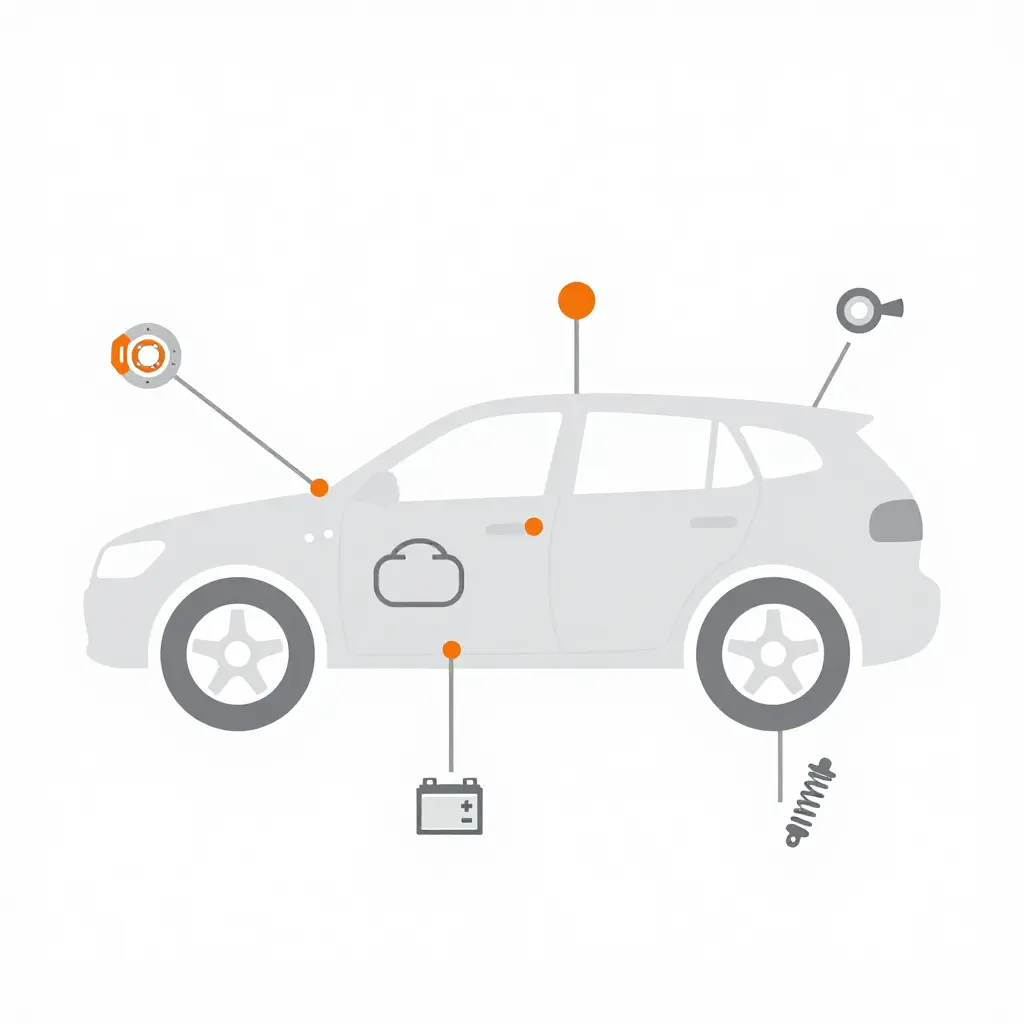
The schematic below maps the five checkpoints a technician walks through on a lift: brakes, tires, belts, battery, and suspension. These are the parts that degrade with heat, friction, and time, which is exactly where two shops tend to disagree about what needs replacing.
Reading the Diagram
Each dot is an inspection point, not a repair. A technician checks pad thickness and rotor condition, tread depth and sidewalls, belt cracking and tension, battery load and terminal corrosion, and shock or strut leaks. That is diagnosis, so a shop’s line-item list grows or shrinks with what was actually found rather than with a fixed menu.
Keep in mind that how brakes wear and how to extend their life varies with driving style, which is why brake line items so often differ between two estimates for the same car.
Why This Matters for Your Quote
A wear inspection answers “what is wearing out?” A fluid replacement answers “what has expired?” They are different jobs that often share one invoice. Once you have the five checkpoints in mind, you can read any quote and sort each line into wear findings (condition-based) or fluid services (interval-based), which explains most of the gap between two estimates for the same car.
Fluid Replacement: What Your Service Actually Covers
Wear inspections find parts that are breaking down. Fluid replacement renews the liquids that keep systems cool, lubricated, and responsive. The two are related but separate, which is one reason two shops can quote different line items for the same car.
The Fluids Typically Serviced
A standard fluid service usually touches the following systems:
- Engine oil and filter – removes the lubricant that has collected contaminants and renews the filter trapping metal and dirt.
- Coolant – controls temperature and protects against corrosion and freezing.
- Brake fluid – carries hydraulic pressure to the brakes and absorbs moisture that would otherwise corrode the system; as its water content rises, its boiling point falls.
- Transmission fluid – lubricates gears and helps hydraulics shift smoothly.
- Power steering fluid – keeps steering effort light and protects the pump and rack.
- Windshield washer fluid – clears the glass for visibility, especially in road spray.
Why Fluids Age With Time and Mileage
Fluids degrade chemically, not just visibly. Heat cycles, oxidation, moisture absorption, and additive depletion happen gradually, often long before anything looks or smells wrong. A fluid can look clean and still be past its protective life, which is why manufacturers set a fluid service interval instead of asking owners to judge by eye. Following that schedule protects components that would cost far more to replace.
If you want to understand how time and mileage each drive those schedules, it helps to review the reasoning behind oil change intervals based on time versus mileage.
Top-Off vs. Flush vs. Full Replacement
These terms are not interchangeable, and knowing the difference prevents surprises on your invoice. A top-off adds fluid to bring a reservoir back to the correct level; it does not refresh what has already broken down. A flush uses pressure to push out old fluid and circulate new fluid through the system, replacing a large share of the total volume. A full replacement drains and refills the system according to the manufacturer’s procedure, which may also involve replacing a filter or pan gasket. Steering systems have their own quirks, and owners researching power steering fluid shelf life and upkeep often discover that age matters as much as mileage. Asking which method a quote includes is the fastest way to compare two estimates fairly.
The comparison below captures how these two common service categories differ; for a closer look at how inspection findings turn into real repairs, see this guide to diagnosing brake problems.
| Dimension | Wear Inspection | Fluid Replacement |
|---|---|---|
| What triggers the service | A technician spots or measures an out-of-spec component during a routine check, or the driver reports a symptom | A mileage or time milestone is reached, or a level dip or fluid test reveals degradation |
| How it is evaluated | Visual and hands-on assessment: tread depth gauges, caliper measurements, play checks, and symptom diagnosis | Physical and chemical testing: color, level, contamination, moisture content, or condition versus manufacturer spec |
| Typical service interval | Condition-based; checked at every oil service, annual inspection, or when a noise or warning appears | Fixed schedule, often every 30,000 to 100,000 miles depending on fluid type and vehicle |
| Type of parts involved | Existing components examined in place, such as brake pads, belts, hoses, bushings, and tires | Consumable fluids that are drained and refilled, such as engine oil, coolant, brake fluid, and transmission fluid |
| How the line item is presented on an invoice | Shown as a diagnostic or labor charge: “inspect brake system” or “check suspension” | Shown as a parts-and-labor charge: “transmission fluid service” or “coolant flush” |
| Skill and equipment needed | Trained eyes, measurement tools, and knowledge of wear tolerances | Correct fluid specification, drain-and-fill equipment, and proper disposal handling |
| Customer decision point | Findings become optional repairs the owner approves or defers | Service stays on the scheduled-maintenance plan the owner usually pre-approves |
| Documentation | Logged as condition notes and remaining-life estimates | Logged as fluid type, quantity, and replacement date |
Why Two Shops Quote Different Line Items
Two shops can look at the same car, agree it needs work, and still hand over quotes that barely resemble each other. The difference is usually not dishonesty but how each shop translates a vehicle service into written terms on the page.
Inspection depth comes first. One shop does a quick visual pass; another pulls the wheels, measures pads with a gauge, and reads fluid condition. The deeper the inspection, the more service line items appear, because more was found and documented.
Fluid handling matters too. Topping off a reservoir is a small line; a full replacement of coolant, brake fluid, or transmission fluid is a larger, separate entry. A shop that tops off shows fewer lines than one that replaces.
Labor packaging changes the shape of the bill. Some shops bundle labor into a single “major service” figure; others itemize every task. Bundled labor shows one big number, itemized labor twenty small ones. Neither is automatically better, but the presentation shapes how the cost reads.
Parts quality tiers move the total quietly. Economy, OEM-equivalent, and premium components are all valid, but they land at very different prices. The software and labor guides a shop subscribes to set its estimated hours, so identical jobs can carry different time allowances. Regional labor rates add the last layer, since hourly charges swing by city and market.
The Main Reasons Quotes Differ
- Inspection depth – thorough checks surface more documented work than quick visual reviews.
- Fluid handling – topping off costs less than full replacement.
- Labor structure – bundled packages show one figure; itemized services show many.
- Parts quality tiers – economy, OEM-equivalent, and premium parts price differently.
- Software and labor guides – different time estimates for the same job.
- Regional labor rates – local hourly charges vary by area.
To compare quotes fairly, ask for itemized service line items and confirm what each one covers. It also helps to know where money can be saved, whether through membership-based repair savings or by knowing what you can reasonably handle yourself. A clear quote is about the right lines, not the most lines.
How a Typical Vehicle Service Cost Is Broken Down
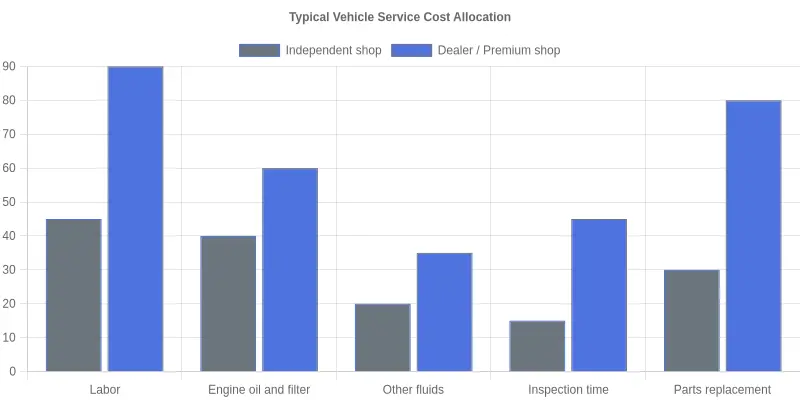
The biggest surprise in a quote is often not the total but how differently the two shops carve it up. The bar chart below compares a typical visit at an independent shop against a dealer or premium shop, split across five common line items: labor, engine oil and filter, other fluids, inspection time, and parts replacement.
Underlying Values
The numbers behind the chart, in U.S. dollars per visit:
| Cost Category | Independent Shop ($) | Dealer / Premium Shop ($) |
|---|---|---|
| Labor | 45 | 90 |
| Engine oil and filter | 40 | 60 |
| Other fluids | 20 | 35 |
| Inspection time | 15 | 45 |
| Parts replacement | 30 | 80 |
Why the Line Items Shift
Two shops can change the same oil and still land on very different totals. The chart shows where that gap lives.
- Labor is the wildcard. Dealer labor runs $90 against the independent shop’s $45, because shop rates, technician certifications, and book-time estimates all climb. Same job, higher hourly math.
- Fluids hide the fine print. One shop tops off the coolant; the other flushes the system and bills it separately. The chart’s “Other fluids” line runs $20 at the independent shop and $35 at the dealer, though a single top-off can cost as little as $10.
- Inspection time is often bundled or billed. Independents frequently treat a multi-point check as a free courtesy, while premium shops itemize it as real diagnostic labor.
- Parts replacement depends on the philosophy. A shop that replaces a part “while we’re in there” inflates the parts line but may save you a repeat visit.
Read together, the chart is less about who is cheaper than about what each shop counts as a service and what it treats as an upsell. When you compare quotes, line them up against categories like these instead of staring at the bottom number, and consider whether extras like a membership or loyalty program help you save on routine car repairs.
Common Vehicle Service Line Items and What They Mean
A vehicle service invoice lists each task a technician performs. The wording can be confusing. Below are the most common service line items on an invoice, explained in plain language.
-
Oil and filter change – Old engine oil is drained and replaced with new oil. The oil filter, which traps dirt and metal bits, is swapped for a fresh one. This keeps the engine lubricated and clean. If you want to plan ahead, learn more about how oil change intervals work.
-
Tire rotation – The tires are moved to different positions on the vehicle. This balances wear, so all four tires last longer and wear more evenly.
-
Brake inspection – A technician checks the brake pads, rotors, and fluid. Worn parts are measured against safe limits to decide if replacement is needed.
-
Fluid top-off or flush – A top-off adds fluid to reach the correct level. A flush removes all the old fluid and replaces it with new fluid. These are two different services with different prices.
-
Cabin and engine air filter replacement – The cabin filter cleans air entering the passenger area. The engine air filter cleans air going into the engine.
-
Battery test – The battery’s charge and overall health are measured. A weak or failing battery may need replacement soon.
-
Multi-point inspection – This is a checklist of checks across the whole vehicle. It covers lights, belts, hoses, and leaks. It is often offered free, but it can lead to recommended repairs.
Knowing these service line items helps you understand what you are paying for. It also makes it easier to compare quotes from different shops.
Every line item follows the same path before it reaches your invoice. It starts as an inspection finding, something a technician actually observes, such as a worn brake pad or low fluid. The shop turns that observation into a recommendation and adds it to the customer quote. At that point you approve or decline: approved work gets done and appears on the invoice, declined work stops there. Because each shop reports its own findings and recommendations, two quotes for the same vehicle rarely match. Keeping a simple record of each visit makes it easier to track what shows up and when.
The Shop’s Job: Make Every Line Item Make Sense
Customers rarely argue about price. They argue about surprise. When a repair order goes from “you need an oil change” to a four-figure estimate, trust evaporates fast. The fix starts with how you present service line items on the page, not after the customer is already at the counter.
Separate the Inspection From the Repair
A wear inspection is a diagnostic act. It costs time, not parts. List it as its own line: “Multi-point inspection – 0.5 hr labor.” Then list each finding as a separate line beneath it, with its own price. That structure tells the customer two things: the inspection was its own service, and each repair is a distinct, optional decision. When inspections and repairs are blended into one lump, customers feel cornered rather than informed.
Explain Fluid Condition, Not Just Fluid Type
A fluid replacement should never appear as a bare line reading “Transmission fluid – $180.” Add the why. Note the measured condition: “Brake fluid: 3.1% moisture (spec under 2%).” Or “Coolant: pH 6.8, depleted corrosion inhibitors.” A number or observation turns a recommendation into evidence the customer can weigh. Without it, you are asking for trust you never earned.
Document With Photos and Measurements
Photos and numbers settle disputes before they start. Snap the glazed brake pad next to a new one. Record tread depth in 32nds of an inch. Save that record alongside the customer’s file — organized history makes this effortless, and for owners hauling heavier rigs, our guide on organizing first-time truck maintenance records shows how digitized records pay off at every visit.
Required vs. Recommended: Say It Out Loud
Draw a hard line between the two. Required means the vehicle is unsafe or out of legal spec — brakes below minimum thickness, a leaking fuel line. Recommended means it is due or trending toward trouble. Label each line item clearly with one word or the other, and never let a recommendation pass as a requirement.
Best Practices for Clear Quoting
- Group all inspection findings in one block and all replacement work in another, so nothing hides in the middle.
- Price each item individually instead of bundling – bundles blur the true cost of every decision.
- Attach a measurement, photo, or condition note to every recommendation.
- Tag each line as “Required” or “Recommended” in plain language.
- Offer good / better / best tiers so customers choose the scope, not just yes-or-no.
- Walk through the quote with the customer and answer questions before any wrench turns.
Transparency is a retention strategy, not a discount. A shop that itemizes clearly, explains fluid condition with evidence, and backs recommendations with measurements gives customers a reason to come back.